Why Plastic Canisters Are No Longer Thrown Away: An Unexpected Trend in Spanish Homes. Plastic canisters are increasingly spared from the trash and given a second life. Spaniards have found new uses for them—from simple flowerpots to original plant containers. We explore why this trend is gaining momentum and how to properly choose and prepare the containers.
An empty plastic jug, which was once thoughtlessly thrown away, is now more often kept in the kitchen or pantry. The reason is simple: many residents of Spain have learned to turn such containers into convenient and durable flowerpots. This approach not only saves money but also helps to reduce waste, which is becoming increasingly important for urban families.
The key point is to choose the right jug. According to Meditec from Castellón, the best option is containers made from durable plastic that is resistant to moisture. Such jugs do not deteriorate from water and do not rust, unlike metal counterparts. This is especially important if the future planter will be placed on a balcony or in the garden, where temperature fluctuations and humidity are common.
Advantages of plastic jugs
Plastic isn't affected by heat or cold, so plants in such containers are more stable. In addition, plastic jugs are easier to work with: they can be simply cut, holes for drainage made, and the edges smoothed if necessary. Meditec recommends choosing cylindrical shapes and carefully checking the container for cracks or weak spots—if any are found, cutting should be done below the damaged area.
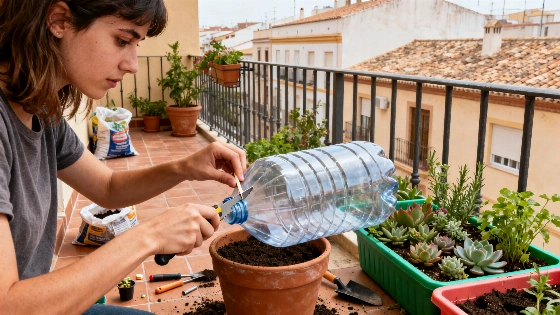
How to turn a jug into a planter
The process does not require special skills. All you need is a clean five-liter canister, a sharp knife or scissors, a marker, fine sandpaper, and a tool for making holes (such as a hot nail or drill). First, mark the cutting line, then carefully cut out the desired section, smooth the edges, and make 4–8 holes at the bottom for drainage. After that, simply add soil and plant your chosen plant.
It is important not to forget the drainage holes: if you don't make them, water will stagnate and the roots will rot. This step is what separates a successful recycling project from an unsuccessful attempt.
Which plants are suitable
Not all plants feel equally good in plastic pots. Hardy varieties are best: succulents, cacti, rosemary, lavender, mint, as well as small flowers like petunias and pansies. The main thing is that the plant does not require too much root space and does not need complex care.
A table prepared by Meditec confirms: succulents and cacti need minimal attention, rosemary and lavender grow well with proper drainage, and mint and small flowers adapt easily to recycled containers.
What to pay attention to
Before using the canister, thoroughly wash and inspect it. If there are cracks or weak spots, make the cut below them. The plastic should be thick and free of chemical odors. After cutting, it is best to go over the edges with sandpaper to prevent cuts.
As Meditec notes, plastic canisters not only surpass metal ones in durability but also in safety: metal can oxidize and release unwanted substances, whereas plastic, if properly chosen, remains neutral.
It is interesting that a similar approach to household solutions is already seen in other areas. For example, in Barcelona, the rules for obtaining the discounted Tarjeta Rosa transport card also depend on details—such as age and place of residence—which highlights the importance of paying attention to details (more on the details of applying for Tarjeta Rosa).
As a result, a plastic canister that was recently considered waste becomes a useful and durable item for the home or garden. This approach not only saves money but also helps care for the environment—without extra effort or cost.