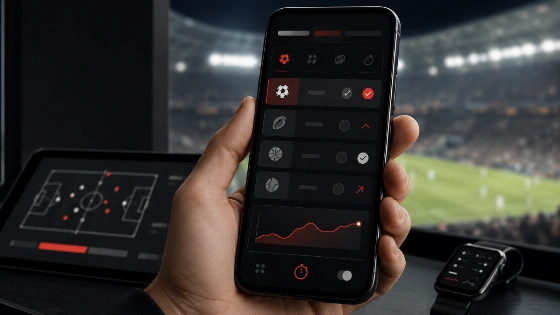
The sports betting ecosystem is migrating toward pocket-sized execution. Over 1.8 billion active punters worldwide utilize a mobile device as their primary wagering interface, abandoning traditional retail cash desks and desktop layouts. This shift forces sportsbooks to operate like high-frequency financial trading desks. The overarching demand from today's smartphone-wielding bettor is blinding speed — a flat refusal to let latency dictate a slip's fate.
With the global online sports betting market soaring past $53.25 billion in 2026, bookmakers are throwing millions into infrastructure to shave precious milliseconds off processing times. This technological arms race has reshaped how fans consume live sports, turning passive viewership into a high-stakes game of split-second calculation. From data ingestion to transaction settlement, the modern mobile loop relies on an intricate tech stack engineered to match live athletic reality. That's why entertainment industry leader Rolsbet is implementing high-load systems and advanced tech solutions.
The Death of Latency: 5G and the 200-Millisecond Blitz
The bettor's worst enemy used to be the spinning wheel of death — that agonizing delay where sportsbooks froze lines while a striker celebrated. In 2026, 5G networks and edge computing have annihilated this technical friction. Desktop setups are losing ground to mobile apps, which command a staggering 84% of online wagering volume. Bookmakers no longer rely on manual line adjustments; instead, machine-learning algorithms process live telemetry feeds to recalibrate in-play prices within a mere 200 milliseconds of an on-field action.
To maintain a competitive edge, premium mobile apps rely on specialized engineering protocols:
- Edge-compute nodes positioned adjacent to major arenas to slash packet transmission times.
- Ultra-low latency WebSockets maintaining a constant pipeline between the user and the odds engine.
- Predictive caching mechanics that pre-load potential market shifts before they render on-screen.
This backend revolution ensures that the price a punter sees matches the exact price locked in when hitting the wager button.
Micro-Betting Madness: Chopping Games into Seconds
The hyper-acceleration of mobile delivery has shifted player preferences toward hyper-localized micro-betting markets. Long-term futures and traditional pre-match accumulator cards feel ancient compared to wagering on the outcome of the very next possession, pitch, or corner kick. In-play markets captured an impressive 57.8% of online sports betting market share, illustrating a permanent behavioral pivot toward instant gratification. Bettors act as high-frequency day traders reacting to micro-events in real time. Fortunately, with solutions like rolsbet mobile, this isn't a problem, as the downloadable program runs flawlessly even during the 2026 World Cup's ranking matches.
The entire lifecycle of a single short-lived market must unfold flawlessly within a tight window:
- Rapid automated market creation immediately following an official stoppage.
- High-throughput bet acceptance frameworks processing thousands of digital slips per second.
- Automated immediate settlement the moment official data providers log the play-by-play event.
This rapid-fire cycle allows a user to turn a quick profit, update their balance, and deploy that capital into a subsequent drive before the quarterback breaks the huddle.
Synchronized Streams and Two-Tap Execution
Historically, live mobile betting suffered from a systemic disconnect — a frustrating five-to-ten-second delay between live broadcasts and the bookmaker's mathematical engine. Operators solved this bottleneck via video synchronization tools like Dolby’s OptiView. By embedding zero-delay video feeds directly alongside the digital wagering slip, mobile interfaces allow users to watch a match and lock in point-level wagers without shifting focus between separate applications.
The user interface has evolved into streamlined mobile environments optimized for thumb-driven ergonomics where punters utilize key features:
- Pre-set stake amounts allowing one-click risk allocation.
- Intuitive gesture-based swiping to modify live slips.
- Dynamic biometrics enabling instant authentication without manual typing.
Eliminating interface friction ensures that punters do not miss out on volatile odds shifts during sudden momentum swings.
The Capital Loop: Payout Velocity and Growth
The ultimate driver of high-velocity decision-making remains the velocity of capital itself. Mobile betting applications are integrating instant digital payment rails and stablecoin-powered settlement mechanisms to facilitate financial fluidity. With stablecoins driving over 70% of crypto-based transactions on regulated platforms in 2026, the era of waiting days for a withdrawal is dead. Punters demand immediate access to winnings to sustain in-play momentum, which drives the projected 14.90% compound annual growth rate for the mobile segment through 2035.
When payouts land in a digital wallet within seconds, user engagement patterns alter dramatically. Punters remain locked into the application throughout the sporting event, recycling their bankroll through dozens of micro-markets rather than placing a single wager. This rapid capital recycling fuels an environment where data analysis, execution speed, and financial liquidity converge into a unified, high-octane mobile experience.