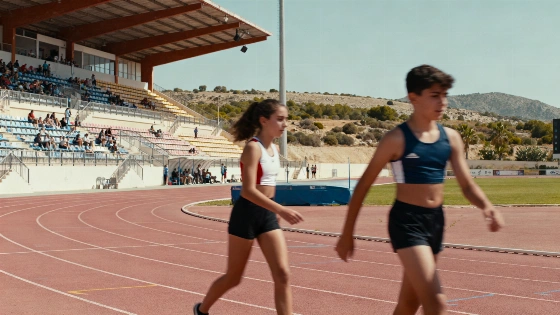
La Nucía to Host Spain’s Largest Youth Athletics Championship. On June 6 and 7, La Nucía will welcome 782 of the country’s top young athletes. The 25th Spanish U16 Championship will take place at Olímpic Camilo Cano Stadium, featuring dozens of finals and a quest for new records.
On June 6 and 7, La Nucía becomes the center of Spanish athletics once again: the Olympic Camilo Cano Stadium will host the 25th Spanish U16 Outdoor Championships. This year, 782 athletes from all regions of the country will take to the track—making it one of the largest competitions for young athletes. The event is organized by the Royal Spanish Athletics Federation, the Valencian Community Federation, and the La Nucía municipality.
Over two days, athletes born in 2011–2012 will compete for medals in both individual and team disciplines. The competition is split into morning and evening sessions. Saturday morning will see the start of the girls' heptathlon and boys' hammer throw, as well as qualifying heats and semifinals in sprint and throwing events. In the evening, there will be ten finals, including jumps, the 1500 m steeplechase, and key sprint distances. On Sunday morning, another ten finals take place, followed by thirteen crucial events in the afternoon, including 4x100 m relays, jumps, throws, and long-distance runs.
Among the 782 registered participants are 397 girls and 385 boys. Facsa-Playas de Castellón has the largest delegation (29 athletes), followed by Alcampo Scorpio 71, CA Safor-Teika, Diputación Valencia C.A., Grupompleo Pamplona At., Trops-Cueva de Nerja, AA Catalunya, Unicaja Jaen Paraiso Interior, and Real Sociedad. In terms of numbers, Catalonia leads (108), followed by the Valencian Community (106), Madrid (100), Andalusia (97), and Galicia (82).
Special attention is focused on five reigning champions who will defend their titles: for the boys, these are José Manuel García (3000 m), Pablo Hernández (hammer), and Marcos Ruiz (3000 m race walk); for the girls — Adriana Solanes (3000 m) and Gabriela Bouzada (javelin). Among the favorites are national record holders and past medalists. For example, Marcos Ruiz (3000 m race walk, 12:10.44), Anna Recuenco (discus, 49.19 m), Elena López (100 m, 12.03), Pedro Muñoz (shot put and discus), Celia Moya (100 m and 300 m hurdles), as well as other athletes ranked in the top 10 all-time results in the U16 category.
Three participants have a chance to achieve a rare double — winning two events. For the boys, this is Pedro Muñoz (shot put and discus); for the girls — Anna Recuenco (discus and shot put) and Celia Moya (100 m and 300 m hurdles). If they succeed, they will join the shortlist of athletes who have accomplished such feats at the national level.
All events will be broadcast live on RTVEPlay (with free registration), and results will be published online on Smartrack (rfea.live) and on the X account @atletismoRFEA with the hashtag “CEatletismoSub14.”
In recent years, La Nucía has strengthened its status as one of the country's main sports centers, regularly hosting major tournaments. For example, Valencia recently hosted the Endesa League quarterfinal between Valencia Basket and Surne Bilbao, which also became a notable event for the regional sports audience — you can read more about this in the article about the start of the Endesa League playoffs.
For reference: the Spanish U16 championships are considered a key stage in the development of young athletes, and many participants from past years have gone on to become medalists in senior national and international tournaments. In 2026, interest in youth competitions is especially high against the backdrop of a growing number of regional athletics schools and support for grassroots sports from municipalities. According to RUSSPAIN, such tournaments not only identify future stars but also help develop sports infrastructure in the regions.