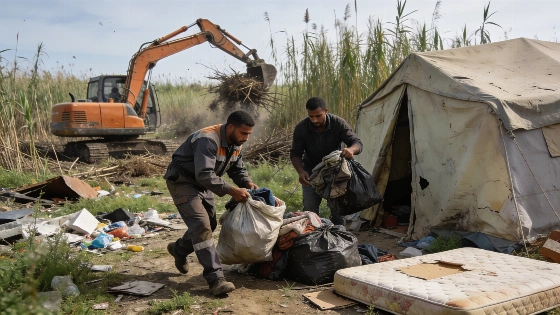
Authorities have started clearing out the illegal camp in Ibiza’s Ses Feixes de es Pratet, a protected wetland where about 80 people have been living in tents and shacks. Residents, many of them workers, were told they had just two hours to get out as excavators arrived.
Excavators arrived at Ses Feixes de es Pratet on Tuesday morning. Dozens of people living in tents and shacks on the edge of Ibiza’s city center had to leave fast. Some were still in work uniforms when they got the order: two hours to clear out of the protected wetland they had called home since last spring.
The eviction came quickly, but many saw it coming. The area is officially listed as a Bien de Interés Cultural. Over time, it turned into a patchwork of makeshift shelters and piles of debris. The authorities made their point clear. The landowner, following city council orders, was reclaiming and cleaning the site, no matter the impact on those living there. Mallorca.com reported that the dispute over the camp had been public for at least a week before the eviction. Local officials had known about the camp since early June. Police used drones to watch the camp’s boundaries.
In August, rental prices in Ibiza reached 31.9 euros per square meter per month, while the average purchase price was estimated at 6,040 euros per square meter, according to Tinsa.
One man from Morocco, who has lived in Ibiza for 25 years and now works in municipal cleaning, packed up his things. He said his last apartment was a shared flat with 11 people, full of fights and drug use. “For me, it’s better to live on the street than with 11 junkies,” he said, hanging wet clothes on a line. His neighbor, also Moroccan, goes to Can Misses hospital every morning for dialysis. Both now face sleeping in cars or searching for another place to stay.
Some had only just arrived. Two young women and a toddler, who had been there for two weeks, rushed to fill bags in a rare clean corner. Others, like Abel from the Sahara, took the eviction in stride. He said he would sleep in his car now, since his job at a car rental company did not come with housing. “There are dirty people here, but it’s not us,” he said, pointing to the piles of trash that have drawn the authorities’ attention.
Mahfod, also from the Sahara, had heard rumors of eviction for a week but only got a firm deadline that morning. He has no job and has been on the island for eight months. If nothing turns up, he plans to head to the mainland. Tommy García from Peru, who works as a gardener, was waiting for a company room at the end of the month. “They charge me 450 euros, which seems fair given how things are in Ibiza,” he said. Until then, he planned to sleep in a work van.
Since 2024, more than 200 people have been evicted from similar informal camps across the Balearic Islands, many of whom were employed in hotels, restaurants, retail, and even public services. The housing crisis is directly linked to the growth of such settlements.
Even people from Europe found themselves with nowhere to go. Guerdundula Schmitz, a 66-year-old German woman, sat on the ground as the excavator circled. She did not know where she and her partner would go next. “We were in sa Joveria before this. I don’t have work now, but I’m looking,” she said, pushing a shopping cart loaded with bags and a dog out of the camp.
Neighbors living near Ses Feixes felt both relief and worry. Vanessa Vivas, who lives next door, said she was concerned about the children in the camp. “The other day it was raining and I saw one of the girls. I just didn’t understand,” she said. She added that some camp residents could be aggressive, but her main worry was for the minors living in those conditions.
Inside the wetland, things had grown chaotic. Locals said an Ecuadorian man now rents out space in the old Can Murtera house to drug users, tapping electricity from the street to power lights and TVs. The area, once valued for its environment, now shows the depth of Ibiza’s housing crisis and the limits of local action. According to que.es, authorities have also stepped up action against illegal tourist rentals. One property was sealed, and a fine of 220,001 euros was proposed in September 2026.
Ibiza’s environment councillor, Jordi Grivé, said the landowner was leading the cleanup at the city’s request. Even with children and chronically ill people present, Grivé said social services had “not detected any vulnerable” residents. He estimated the cleanup would take about a week because of the amount of waste and the need to sort materials. The city’s commission on illegal settlements keeps monitoring these camps every week, with environment, urban planning, and social services working together.
The eviction at Ses Feixes is not finished yet, but the message is clear. Informal camps, even in protected areas, will not be allowed to stay. The fast clearance, with just two hours’ notice, shows how unstable life is for many foreign workers and migrants who keep Ibiza running but cannot pay its high rents. As reported earlier, Spain’s legal and social systems often leave the most vulnerable with few choices. What happened in Ses Feixes is a sharp reminder that under Ibiza’s glamorous image, the fight for shelter is urgent—and real solutions are still out of reach.