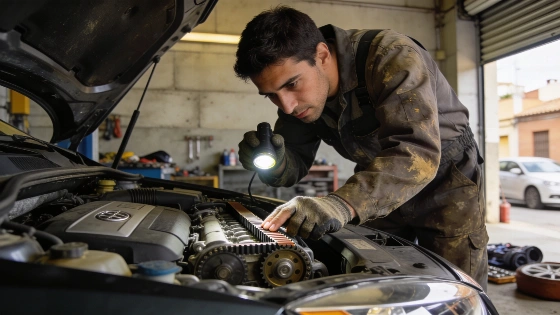
Miss the real timing belt deadline and you risk a ruined engine. Many drivers watch the odometer, but the real danger is ignoring the years. Here’s why your car’s manual—not your mileage—holds the answer.
One broken timing belt can turn a working engine into scrap. When the belt snaps, pistons and valves fall out of sync and often collide, sometimes leaving engine replacement as the only fix. Citroën warns that a failed belt can cause instant, severe damage.
The bigger risk isn’t just mechanical—it’s how people think about maintenance. Most drivers focus on kilometers, waiting for the odometer to hit the next service mark. But time is the silent threat. Even a car that sits in the garage can reach its timing belt’s expiration date years before it hits the mileage limit. Five years can pass quietly, long before you see 60,000 kilometers on the dash.
According to the Spanish Directorate-General for Traffic, timing belt failures are among the top causes of catastrophic engine breakdowns in vehicles over 8 years old.
This confusion resurfaced after a 14-year-old video from mechanic Roberto Casas made the rounds again in August 2026. In the clip, Casas says to replace the timing belt "every 60,000 kilometers or five years at most," but he adds an important warning: "Always check with the manufacturer." That’s not just a formality—it’s the only way to avoid expensive mistakes.
Manufacturers set their own intervals, and they rarely match the generic numbers you see online. Renault España, for example, lists replacement intervals from 60,000 to 160,000 kilometers or five to ten years, depending on the model and engine. The only reliable answer is in your car’s maintenance book, the brand’s app, or your last service paperwork. You also need to know if your engine uses a belt or a chain—many drivers don’t realize the difference until it’s too late.
Ignoring the calendar is a risk. Renault points out that waiting for symptoms—strange noises, hard starts, or odd vibrations—won’t help. By the time you notice warning signs, the damage may already be done. The belt’s lifespan is set by the manufacturer, not by how "normal" your car feels or how few kilometers you’ve driven since the last change.
A 2025 report by the Spanish Association of Automotive Workshops found that nearly 40% of timing belt failures occurred in vehicles whose owners exceeded the recommended replacement interval by more than two years. The report also highlighted that many drivers were unaware of the time-based limit, focusing only on mileage.
Changing the timing belt isn’t always a simple job. Citroën’s standard kit includes not just the belt, but also tensioners, rollers, and sometimes the water pump if it’s driven by the belt. Before agreeing to any quote, drivers should check four things: whether their engine uses a belt or chain, the exact interval for their model, the date and mileage of the last replacement, and whether the quote covers all needed parts.
For used cars, the risk is higher. Without a clear invoice or service record, you can’t judge the belt’s age by looking at it. As Talent24h points out, missing documentation should be a warning sign—especially if the model is known for mechanical problems.
The idea of a universal "60,000 kilometers or five years" rule is a shortcut that can cost thousands. The only numbers that matter are the ones set by your car’s maker. Relying on generic advice or waiting for trouble is a gamble. The smart move is to follow the manufacturer’s interval—whether it’s time, distance, or both.