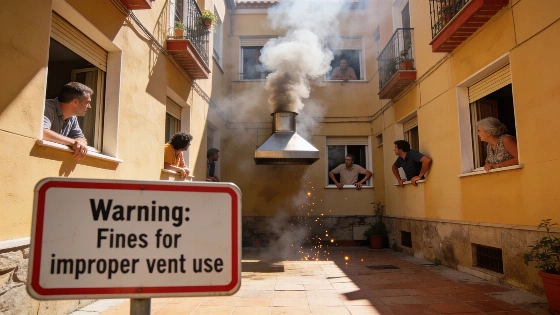
Homeowners who vent kitchen smoke or barbecue fumes into courtyards or shared spaces risk significant fines if their installations break local rules or disturb neighbors. Summer brings a surge in complaints about odors and soot entering nearby homes.
Installing a kitchen extractor or barbecue vent that releases smoke into an interior courtyard or shared area can quickly become an expensive mistake. Across Spain, local councils are empowered to fine residents whose cooking fumes, soot, or persistent odors disturb neighbors or violate building codes. As temperatures rise, so do complaints about smoke drifting through open windows and settling on facades, especially in older buildings or apartments with poorly adapted renovations.
Fines are not issued for every neighborly complaint. Instead, penalties are reserved for cases where the extractor or barbecue setup fails to meet technical standards or causes proven harm to other residents. The issue is particularly common in properties where kitchen renovations have not included proper ventilation ducts, or where terraces are used for grilling with charcoal or wood, sending smoke directly into communal spaces.
When Fines Apply
Spanish building regulations, specifically the Código Técnico de la Edificación, require that kitchen extraction systems use dedicated mechanical ducts, separate from general home ventilation. These ducts must expel fumes above the building’s roof, away from windows, balconies, or terraces where people gather. Directly venting smoke into a courtyard or onto a facade is not only a technical violation—it can also trigger municipal sanctions if it disrupts daily life or creates persistent smells.
In Madrid, for example, the Ordenanza de Calidad del Aire y Sostenibilidad sets fines of up to €750 for minor infractions, €1,500 for serious breaches, and as much as €3,000 for the most severe cases. The ordinance classifies the absence of proper extraction systems or failure to meet technical requirements as very serious offenses. If a homeowner ignores municipal orders to fix the problem, additional coercive fines of up to €3,000 may be imposed.
Community Action and Legal Recourse
Municipal intervention is not the only route for affected neighbors. Communities of property owners can also act if a resident’s extractor or barbecue is deemed a nuisance, health hazard, or safety risk. The Ley de Propiedad Horizontal prohibits activities that violate building statutes, damage the property, or create unhealthy or dangerous conditions. The community president can formally request the offending resident to stop, and if the issue persists, the community may take the matter to court with the approval of the owners’ assembly.
Spanish civil law further protects neighbors by requiring minimum distances and safety measures for installations like chimneys or ovens near shared or adjacent walls, aiming to prevent harm from smoke or fire.
Barbecues: A Seasonal Flashpoint
Summer often brings a spike in disputes over barbecues, especially those using charcoal, as smoke and odors drift into nearby homes. In Madrid, cooking activities in multi-unit buildings must be at least five meters from the nearest window or opening on the same or higher level, and three meters from flammable materials. While not all private barbecues are banned, each municipality can set its own rules. Fines may be issued if smoke, soot, or fire risks arise, or if technical and distance requirements are ignored.
For residents considering kitchen renovations or outdoor cooking, understanding local regulations and ensuring proper ventilation is essential. Ignoring these rules can lead not only to neighborly tension but also to significant financial penalties.