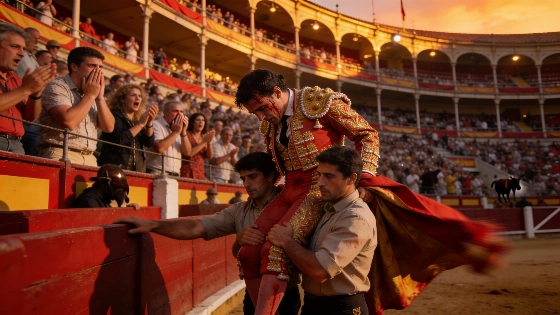
The last bullfight of the Santiago Fair in Santander ended with high drama. Marco Pérez was seriously injured, while decisions by the president sparked outrage. Morante de la Puebla and Aarón Palacio delivered standout performances.
The closing bullfight of the Santiago Fair in Santander was overshadowed by a serious injury to young torero Marco Pérez and heated controversy over the awarding of trophies. The packed Plaza de Cuatro Caminos witnessed a tense afternoon as the Juan Pedro Domecq bulls proved both challenging and unpredictable, pushing the three featured matadors—Morante de la Puebla, Marco Pérez, and Aarón Palacio—to their limits.
Marco Pérez suffered a severe goring to his right thigh while attempting the kill on his first bull. The incident brought the action to a halt as Pérez was carried from the ring and immediately operated on by the medical team led by Dr. Casanova. The medical report described two wound tracks affecting the adductor muscle and reaching the rectus femoris, with a reserved prognosis. Pérez was later transferred to Hospital de Mompia in Santander, and his condition prevented him from continuing in the ring.
The injury did not go unnoticed by the crowd, who responded with a strong demand for Pérez to be awarded two ears for his courageous and technically impressive performance. However, the president of the event granted only one ear, a decision that triggered a wave of protests and a loud backlash from the stands. The same pattern repeated with Aarón Palacio, whose determined and skillful work with his bulls was met with only a single trophy, despite a clear groundswell of support from the audience for greater recognition.
Morante de la Puebla, the star attraction of the day, drew a full house and delivered moments of high artistry, especially in the final act. His handling of the sixth bull, marked by slow, elegant passes and a display of classic technique, electrified the arena. Yet, repeated failures with the sword denied him the triumph of a grand exit. The atmosphere in the bullring was charged, with emotions running high as the crowd alternated between ovations and frustration at the official decisions.
Aarón Palacio also stood out, particularly with his work on the fifth bull, where his verónica passes and gaoneras were executed with notable composure and style. Despite a strong performance and a dramatic finish, Palacio too was limited to a single ear, prompting further discontent among spectators. The president's reluctance to grant higher honors became a focal point of the day's controversy.
As the event unfolded, the threat of rain and the tension in the stands added to the intensity. The bulls from Juan Pedro Domecq were described as strong and heavy, with the last two showing more noble qualities, allowing for moments of genuine artistry. The medical team’s swift intervention and the professionalism of the cuadrillas were crucial in managing the aftermath of Pérez’s injury.
Such dramatic afternoons are not uncommon in Spanish bullfighting, where the combination of risk, artistry, and public sentiment often leads to heated debate. The events in Santander echo the kind of public reaction seen during other high-profile incidents in Spanish arenas, reminiscent of the national attention drawn by emergencies such as the wildfires in Madrid and Ávila, which also stirred strong emotions and public support, as reported in coverage of the Madrid and Ávila wildfires.
Bullfighting remains a deeply rooted tradition in Spain, with each event reflecting not only the skill and bravery of the participants but also the passions and expectations of the public. The outcome of the final corrida in Santander underlines the ongoing debates about judging, safety, and the evolving role of tradition in contemporary Spanish society. The Santiago Fair’s last afternoon will be remembered for its intensity, the resilience of its toreros, and the unresolved controversies that continue to shape the world of Spanish bullfighting.