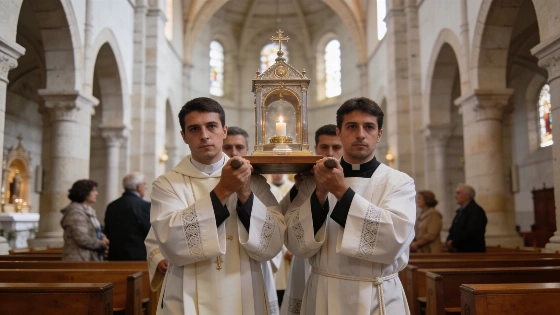
The urn containing the martyrs’ relics was carried to the altar as the ceremony reached its most moving moment. The cathedral bells rang after Cardinal Marcello Semeraro read the decree proclaiming the 80 people blessed. The beatification took place on 7 November 2026 at Santander Cathedral, with Semeraro presiding on behalf of Pope Leo XIV.
About 400 people travelled from Navarre to Santander for the ceremony. Among them were relatives of three new blesseds with links to the region: laymen Manuel Arizcun Moreno and José María Soler Pla, and Discalced Carmelite Ruperto de la Cruz (Ruperto Andueza Larraya).
The family gatherings were substantial. Around 150 descendants of the Arizcun-Zozaya family came from Pamplona, while 250 descendants of the Soler-Zulategui family met in Santander. A diocesan-organised coach trip brought another 100 people. Europa Press reported that the cathedral was full, with relatives and other faithful queuing before the ceremony.
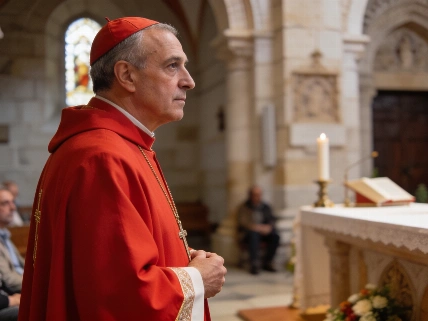
Cardinal Marcello Semeraro, prefect of the Dicastery for the Causes of Saints, presided. The Archbishop of Pamplona-Tudela, Florencio Roselló, concelebrated with 14 other bishops and 150 priests. Gabriel Garralda Arizcun, a grandson of Manuel Arizcun, read one of the lessons.
Demand for places prompted organisers to put a marquee with a large screen in Plaza Alfonso XIII. The ceremony also featured the unveiling of a painting of the new blesseds by Indalecio Sobrino and a procession carrying their relics to the altar.
Roselló praised the congregation’s silence and described an atmosphere shaped by closeness to the martyrs and admiration for their faith. In his homily, Semeraro said the 80 had remained faithful to Christ and forgiven those who killed them. He also presented their example as a reminder of the common vocation to holiness shared by all the baptized.
The cause was led by Francisco González de Córdova, parish priest of Santoña. The group included diocesan priests, Carmelite religious, seminarians and laypeople, who were killed in different parts of Cantabria during the first months of the Civil War. Vatican News gives the group’s composition as 67 diocesan priests, three Carmelite religious, three seminarians and seven laypeople. Most were detained by militiamen and held at Santander’s Checa Neila or aboard the prison ship ‘Alfonso Pérez’ in the bay. Some were shot; others were thrown into the sea with stones tied to their bodies.
Ruperto de la Cruz was born in Garrués, Navarra, and worked as the porter at his convent. Among the laymen, Arizcun led Acción Católica in Navarra, while Soler was a Valencian teacher who lived and was buried in Pamplona. He and his wife, Fermina Zulategui, taught at a state school in Revilla de Camargo, Cantabria.
Arizcun was arrested in Suances while on holiday with his family. Soler was seized at home by militiamen disguised as Civil Guards. Both men were fathers of large families and had defended Catholic education.
The Navarre delegation included Javier Leoz, parish priest of San Lorenzo and organiser of the trip, and Óscar Azcona, parish priest of San Agustín. Arizcun is buried at San Agustín in Pamplona. Azcona encouraged people to visit the church and pray before the new beato. A separate report on preparations for a Madrid martyr beatification appeared in an earlier report.
Members of Pamplona’s Hermandad de la Pasión also travelled to Santander. Arizcun belonged to the brotherhood, while Fermina Zulategui was a member of the Hermandad de la Soledad.