The Interior Ministry must decide if Antonio Balas, head of UCO’s anti-corruption unit, will remain in his post after his promotion to colonel. The outcome could affect major ongoing probes involving top officials.
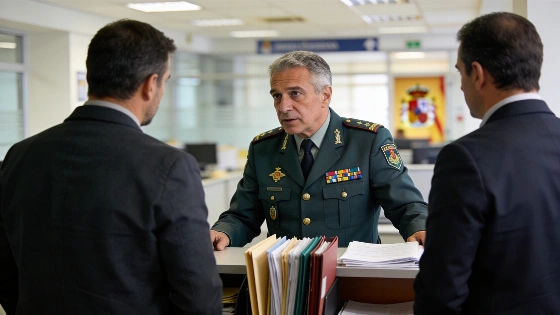
The Ministry of the Interior is under pressure to determine the future of Antonio Balas, the current head of the anti-corruption department within the Guardia Civil’s Unidad Central Operativa (UCO), as his imminent promotion to colonel could force his departure from the unit. Balas has led several high-profile investigations involving the PSOE and government figures, making the decision over his continued role unusually sensitive.
Balas’ advancement, set to be formalized in the coming days in the Ministry of Defence’s official bulletin, typically requires a move to a new post matching his new rank. However, a formal request from National Court judge Ismael Moreno and the public prosecutor has complicated the process. Both have asked that Balas remain in charge of the “Koldo case,” which centers on alleged corruption within the Ministry of Transport during José Luis Ábalos’ tenure. This judicial intervention has forced the Guardia Civil’s leadership to consider whether to keep Balas at UCO and under what terms.
The promotion itself was expected, as Balas ranks sixth among lieutenant colonels due for elevation as of July 1. Yet, the timing is fraught: tensions between the Guardia Civil and the government have escalated since an investigation led by Balas resulted in charges against the director general, Mercedes González, and her deputy, Lieutenant General Manuel Llamas, for allegedly pressuring the unit to hinder probes affecting the PSOE and the family of Pedro Sánchez.
According to sources within the force, the judge’s request makes it almost inevitable that Balas will stay at UCO for now, especially given the language used by both the magistrate and prosecutor Luis Pastor. The court emphasized that Balas’ continued leadership is essential “for as long as necessary” to complete the investigation, citing his central role in uncovering alleged wrongdoing by Ábalos and his former adviser Koldo García.
Administratively, the Guardia Civil can keep Balas in his current role through a “commission of service,” a mechanism allowing officers to temporarily occupy posts outside their formal rank. This approach has precedent: two other UCO lieutenant colonels remained in their posts after promotion for operational reasons. Such commissions typically last up to a year but can be extended in exceptional cases.
Before any extension is granted, several internal steps are required. First, UCO chief Colonel Pedro Merino must submit a report on the advisability of Balas’ continued leadership, which is then reviewed by the Judicial Police Command, headed by General Alfonso López Malo. López Malo, a former UCO chief, has previously testified in related cases, reinforcing suspicions of external pressure on the unit. In similar situations, these internal reviews have generally supported continued service, but the final decision rests with the General Staff, which oversees personnel policy. Sources suggest that approval is likely, given the frequency of such commissions.
The form of Balas’ continued presence at UCO remains uncertain. One option is to keep him as head of the anti-corruption department, leaving the lieutenant colonel’s post unfilled and allowing him to oversee all ongoing and future investigations during his commission. Alternatively, he could be limited to cases where judges have specifically requested his involvement. In this scenario, a new competition would be held to fill the department head position, and the new appointee would take over other investigations. This dual-leadership arrangement could create internal friction, and some lieutenant colonels have reportedly been approached about applying for the post, so far without success.
Balas became a public figure in May last year after a video surfaced showing Leire Díez, a former PSOE member, and businessman Javier Pérez Dolset attempting to persuade another businessman, Alejandro Hamlyn, to provide compromising information about Balas. The recording included the phrase, “If Balas is dead, better,” highlighting the high stakes of the investigations he leads. By then, Balas was already at the center of UCO’s most sensitive probes involving the government and PSOE.
He directed the search of the office of then Attorney General Álvaro García Ortiz on October 30, 2024, and defended a key report before the Supreme Court that implicated the prosecutor in leaks targeting Isabel Díaz Ayuso’s partner. His testimony was also crucial in the convictions handed down by the Badajoz Provincial Court against David Sánchez, the prime minister’s brother, former Extremadura PSOE leader Miguel Ángel Gallardo, and others for alleged irregularities in public contracts.
Balas also testified in the trial that resulted in Ábalos’ 24-year prison sentence for corruption and has been involved in the investigation of Begoña Gómez, the prime minister’s wife, who faces trial for embezzlement, influence peddling, business corruption, and misappropriation of trademark, as ordered by Judge Juan Carlos Peinado.
The situation echoes other recent cases where the future of senior officials has become a point of contention between institutions. For example, the appointment of former Madrid regional leaders to advisory roles, as reported in this analysis of Madrid’s commission appointments, illustrates how personnel decisions can have broader political and operational consequences.
In Spain, the UCO is a key investigative body within the Guardia Civil, often handling complex corruption and organized crime cases. The outcome of Balas’ situation could set a precedent for how the force manages promotions and judicial requests in politically sensitive investigations. The coming weeks will clarify whether the Interior Ministry prioritizes operational continuity or adheres strictly to established personnel protocols.