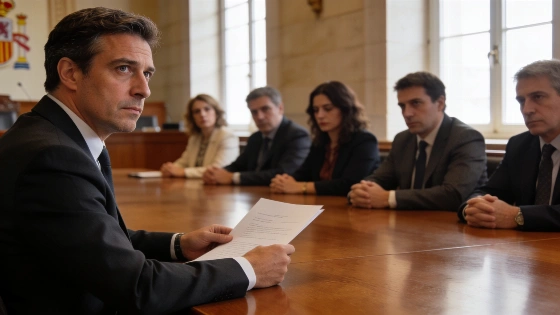
A senior member of Spain's Judicial Council has accused colleagues of putting government interests ahead of judicial independence, exposing deep divisions and raising concerns about political interference in the justice system.
Spain's top judicial body is facing a sharp internal conflict after Carlos Hugo Preciado, a member of the Consejo General del Poder Judicial (CGPJ) associated with the progressive bloc, publicly accused nine fellow council members of acting in line with the Ministry of Justice. In a strongly worded statement, Preciado claimed these members have put the council's independence at risk by following the political agenda of Minister Félix Bolaños.
This dispute followed criticism from the progressive bloc aimed at CGPJ president Isabel Perelló for her comments at the official opening of the judicial year. The nine council members released a statement urging Perelló not to blame the Ministry for the justice system's problems. Preciado defended Perelló's right to speak about the challenges facing Spain's courts, arguing that suppressing such criticism only shields the government from scrutiny. According to Spanish media, Perelló's speech on September 10, 2026, was a direct response to political pressure on the judiciary, where she insisted that judicial decisions are made "without influences, pressure, or interference."
The opening of the judicial year on September 10, 2026, was attended by King Felipe VI and Minister of Justice Félix Bolaños, underscoring the high political significance of the event.
Preciado warned that the CGPJ risks becoming a political tool if it continues to put the executive's interests ahead of its own independence. He argued that real loyalty to the institution means defending its autonomy, even when it is uncomfortable. He accused his colleagues of weakening the council's authority by sidelining the president from important decisions and only seeking dialogue when it suits their position. Several Spanish legal publications have noted that this rare public split within the CGPJ reflects broader tensions between the government and the judiciary over issues like "lawfare," judicial reforms, and the ongoing strain on Spain's courts.
Preciado also accused the progressive bloc of using their political identity to deflect criticism, highlighting government achievements while ignoring the practical problems and resource shortages caused by new efficiency laws. He argued that this selective silence is not progressivism but bureaucratic corporatism that ends up protecting the Ministry rather than the courts. Independent reports say Preciado has repeatedly stressed that cooperation with the executive must not become subordination, and that the CGPJ's independence from both the government and the Ministry of Justice is essential for the rule of law.
He was direct: the CGPJ should not become a territory controlled by political parties, nor should it swap old factionalism for new dependence on the executive. Preciado said collaboration with the government is necessary, but it must not cross into subordination. He also criticized the growing focus on productivity targets, warning that treating judges as bureaucrats tasked with meeting ministry quotas undermines the judiciary's purpose.
According to Spanish press coverage, the 2026 judicial year opening was described as one of the most tense in recent memory, with mutual accusations exchanged between CGPJ blocs following Perelló's speech. The president also highlighted that the Spanish justice system remains too slow and unable to handle the volume of incoming cases, adding a practical dimension to the political conflict.
Spanish media
This internal conflict comes as the relationship between Spain's judiciary and the government faces growing scrutiny. Recent disputes, including those involving Minister Bolaños and the council's handling of disciplinary matters, have already drawn national attention. For example, the issue of judicial independence was highlighted in a recent case where the council refused to sanction a judge, sparking further debate about political influence.
The CGPJ is responsible for protecting the independence of Spain's judiciary, a principle set out in the constitution and essential for public trust in the legal system. When internal divisions become public and accusations of political subordination are made from within, the institution's legitimacy is put at risk. Preciado's challenge points to a deeper problem: if the council cannot keep a clear distance from government interests, its ability to act as a check on executive power is weakened. The current crisis is a warning that the CGPJ must reaffirm its independence or risk losing the confidence of both the judiciary and the public.