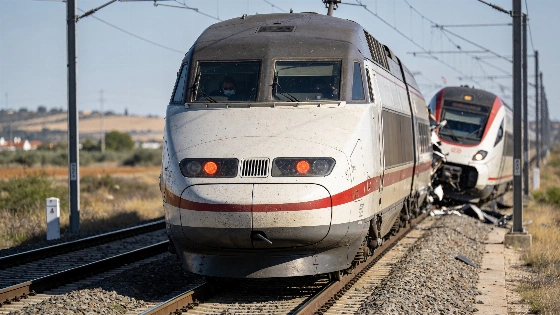
At 8.53, a Renfe AVE struck a stationary Iryo train near Urda, between Mora and Orgaz in Toledo, after both services had stopped during an LZB failure, according to Transport Minister Óscar Puente. Reuters reported that the Iryo train had stopped at a red signal. The collision derailed two Iryo carriages and left 69 people dead and more than 200 injured. Castilla-La Mancha authorities said 147 people were aboard the Iryo service and 397 were travelling on the Renfe train.
The sequence began with a computer failure that took the LZB system out of service on part of the high-speed line. LZB supervises communication between trains and trackside infrastructure. It automatically stops a train if that communication is lost. Adif’s control centre at Atocha took over traffic management. At 8.36 it authorised the Renfe AVE to resume normal running. The Iryo train ahead received an order to move at 8.41, but seven minutes later its driver reported that it would not start. The Renfe train hit it while it remained stopped.
The events recalled a warning Iryo chief executive Fabrizio Favara gave to a Senate inquiry on 5 October, 23 days before the crash. He told the committee investigating the Adamuz and Gelida rail accidents that LZB disconnections were the most frequent problem reported on the Madrid-Seville corridor. Favara appeared before the commission examining Spain’s rail network in response to a question from Vox senator Javier Alonso.
Favara described LZB as safe but old. The system sends information between railway infrastructure and trains to supervise movement and maintain safety conditions. When communication fails, trains stop automatically. Favara said a train cannot move until the connection is restored, a process that can take considerable time and delay a return to service.
Audio from the drivers’ calls to Adif’s Atocha control centre also featured in earlier reporting on the order for the AVE to proceed while the Iryo remained unable to restart. Reuters reported that the crash occurred near Urda, about 118 kilometres south of Madrid by rail, and that high-speed services between Madrid and southern Andalusia were suspended after the collision.
Favara also pointed to a gap in how fault reports are handled. Drivers must report irregularities to Adif’s traffic regulation centre, he said, but the rules do not require Adif to tell the railway company what inspections or repairs it carries out afterward.
He said Adif is responsible for infrastructure risk assessment, while operators follow the movement permissions and speed instructions issued by the control centre. Iryo and other operators, he told senators, do not assess infrastructure risk themselves.