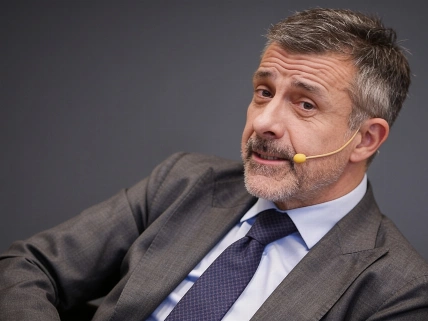
Javier Negre, once a mainstream journalist, now leads a global network accused of spreading political disinformation. His operations reach from Madrid to Washington and Buenos Aires, raising questions about funding and influence.
Javier Negre, a former reporter for El Mundo, has rapidly transformed into a central figure in the international ultra-right media landscape. His rise, marked by aggressive networking and controversial tactics, has positioned him as a key intermediary between Spanish-speaking audiences and political powerhouses like Donald Trump and Javier Milei. Negre's activities, which span Madrid, Washington, and Buenos Aires, have drawn both admiration and sharp criticism for their role in amplifying political propaganda and monetizing access to influential circles.
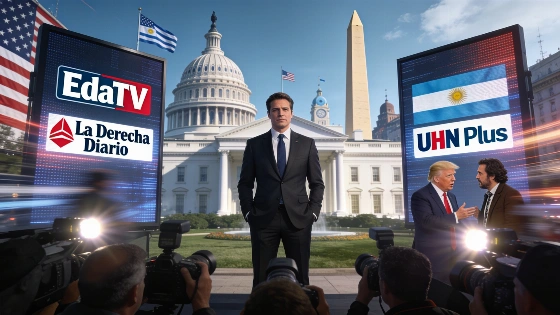
Negre's media ventures, including EdaTV, La Derecha Diario, and UHN Plus, have been repeatedly accused of spreading misinformation and fueling political polarization. According to El País, his business model relies on a mix of private advertising, public funds from administrations led by Spain's Partido Popular, and opaque deals with ideologically aligned entrepreneurs. Notably, his platforms have received at least €680,000 from Spanish public administrations between 2020 and 2025, while private investors such as María José Álvarez Mezquíriz and Marcos de Quinto have injected significant capital. Despite this, Negre maintains that his operations are dwarfed by the funding received by left-leaning outlets.
Negre's expansion into Latin America accelerated after Javier Milei's election in Argentina. He quickly established himself in Buenos Aires, acquiring a stake in La Derecha Diario and leveraging connections to secure interviews and visibility. His approach, often provocative and confrontational, mirrors the tactics of his protégé Vito Quiles, who has also faced legal scrutiny in Spain. Negre's ventures have benefited from state-linked advertising in Argentina, including contracts with the semi-public oil company YPF, though the full extent of this funding remains undisclosed.
In the United States, Negre has cultivated relationships within the Trump movement, gaining access to exclusive venues and securing a permanent press pass at the White House. He presents a weekly program on Real America’s Voice, a network associated with Steve Bannon, and claims to be the primary Spanish interlocutor for the Trump administration. Critics, however, argue that his influence is overstated and that his primary asset is the ability to sell access and visibility to political and business clients across the Americas.
Negre's methods have sparked controversy among former colleagues and political operators. Allegations include the use of underpaid staff, the rapid dissemination of unverified or misleading content, and the solicitation of payments for arranging meetings with high-profile figures. While Negre denies acting as a lobbyist, multiple sources cited by El País and other outlets suggest otherwise. His business practices have led to legal complaints, including a recent filing by Argentine deputy Marcela Pagano, who accuses him of facilitating paid access to President Milei's inner circle.
The rise of Negre and his network reflects a broader trend in Spanish and Latin American media, where digital platforms and social media have enabled rapid audience growth and direct political engagement. His story parallels other high-profile figures who have leveraged controversy and polarization to build personal brands and business empires. For context, similar dynamics have been observed in other Spanish public life, such as the evolving roles of prominent families and public figures, as discussed in this recent analysis of the Thyssen-Bornemisza twins.
Negre's trajectory from mainstream journalism to the heart of the international ultra-right underscores the changing nature of media influence in the digital age. His operations, while divisive, highlight the growing intersection of politics, business, and information warfare across Spain and the Americas. As legal and ethical questions mount, the impact of his network on public discourse and political outcomes remains a subject of intense debate.
For additional context, Spain has seen a notable increase in the influence of digital-first media outlets, particularly those aligned with political movements. The use of social media platforms like X (formerly Twitter) has amplified the reach of figures such as Negre and Quiles, allowing them to bypass traditional gatekeepers and directly engage with large audiences. This shift has prompted calls for greater transparency in media funding and stricter enforcement of journalistic standards, especially as misinformation and political agitation become more prevalent in the public sphere.