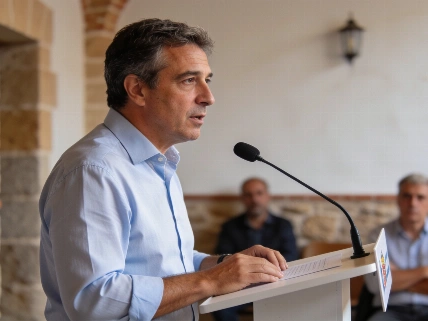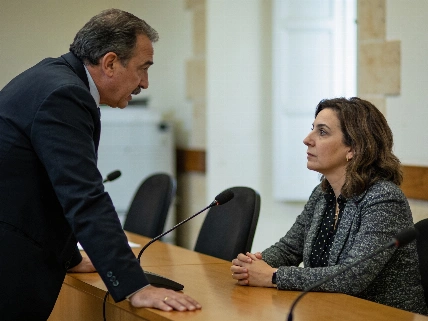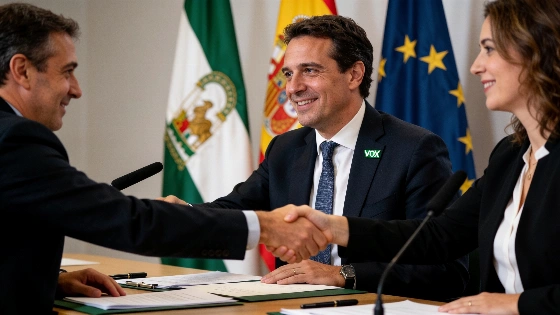
Juan Manuel Moreno, leader of the Partido Popular in Andalucía, has been sworn in for a third term as president of the Junta de Andalucía after sealing a governing agreement with Vox. Reached just before the decisive parliamentary vote, the deal gives Vox regional leader Manuel Gavira a vice-presidential-level portfolio covering tourism and deregulation, as well as justice and local administration. It marks Vox’s first direct participation in the regional executive, taking the party beyond parliamentary support. The agreement followed the Partido Popular’s loss of the absolute majority it held in the previous legislature, making Vox’s backing decisive.
The pact is described as a 150-measure agreement. Its final provision requires the PP and Vox parliamentary groups to vote together on agreed matters. Together, the parties hold more than three-fifths of the chamber, giving them influence over parliamentary institutions and oversight bodies. The arrangement gives Vox both executive responsibility and use over legislative decisions.
Moreno accepted several of Vox’s basic demands, including the adoption of its “national priority” principle in areas such as housing and social assistance. Vox spokesperson Javier Cortés said the pact would make that priority a reality. The agreement also commits the regional government to build 20,000 homes for Andalusians over four years. Vox contrasted that target with its claim that the central government built 800 public homes in Andalucía over the preceding eight years. The pact also backs the deportation of people in an irregular immigration situation.
During the election campaign, Moreno emphasized moderation and warned that relying on Vox could bring instability, citing earlier legislative deadlocks over budgets and basic laws. The new agreement nevertheless includes policies he had previously rejected, particularly on immigration and the treatment of unaccompanied foreign minors. It opposes the central government’s migration policies and commits the Junta to resist the redistribution of undocumented migrants, both adults and minors. Moreno had previously defended Andalucía’s willingness to care for unaccompanied minors and challenged rhetoric portraying foreigners as criminals.
The pact also calls for reducing, “until elimination,” public subsidies that do not directly and verifiably improve Andalusians’ quality of life, with particular attention to international development aid. After the agreement, the Junta withdrew or did not renew initial grants for organizations serving migrants and homeless people. Moreno’s government disputed that the funding decisions resulted from the pact, although they followed it and were reported in that political context.
Vox’s direct executive role is concentrated in one broad portfolio, but its influence also reaches parliamentary votes and institutional agreements. Reporting on the alliance also described the 2027 Andalusian budget, with expenditure of €54.716 billion, as the first budget Vox supported under the new arrangement. The agreement marks a impressive shift for Moreno, whom ABC has characterized as one of the Partido Popular’s more centrist regional leaders. Polling cited by the newspaper showed no evident decline in his public standing after the deal.
Andalucía is Spain’s most populous region and a basic political battleground. Vox’s entry into the regional executive reflects a wider pattern of right-wing alliances in Spanish regional politics, following agreements in Extremadura, Aragón and Castilla y León. The national-priority principle remains contentious, particularly because immigration policy is set at the national level. The alliance’s consequences are already visible in housing commitments and migration policy, as well as in public grants and the balance of influence over regional institutions.