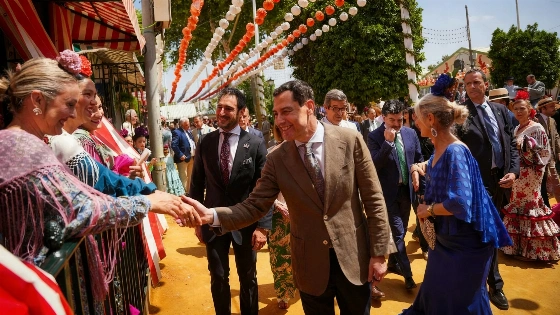
Why the President of Andalusia Calls Himself ‘An Andalusian to the Core’. The President of Andalusia, Juanma Moreno, is once again in the spotlight. His background and family history are under scrutiny. Spanish media are discussing details of his relocation, career, and personal life.
Spanish gossip columns are once again discussing the figure of Juan Manuel Moreno — President of Andalusia, who never misses a chance to emphasize his connection to the region. But it is his origins that have sparked new conversations: despite his loud claims of being “Andalusian to the core,” he was not actually born in Andalusia, but in Barcelona. As noted by Divinity, this unexpected fact does not stop him from remaining one of the most recognizable figures in southern Spain.
Family history and relocation
The Moreno family did not end up in Catalonia by choice: the future politician’s parents left their native Alhaurín el Grande in search of work. His father worked both as a delivery man and a taxi driver, while his mother was employed at a large store. But just three months after their son’s birth, the family returned to Málaga, where Juan Manuel would spend his childhood and youth. Memories from that period are colored not only by the family’s efforts—their lives also took an unexpected turn: in 1977, the family got lucky and won the second prize in the Christmas lottery. This win allowed them to move to the more prestigious Puente de Américas neighborhood, where the future president began to dream big.
Music, studies, and first steps in politics
In his youth, Moreno had no dreams of a political career. Music played an important role in his life: he was a vocalist in several pop-rock bands, performed on local stages, and worked part-time in a pizzeria and a bar. Later, he enrolled at the University of Malaga to study psychology and pedagogy, but never graduated—politics took over. At just 19, he joined the Partido Popular, and by 23 he was leading Nuevas Generaciones in Malaga, and later at the national level. Moving to Madrid marked a new phase: it was there that he met Manula Villena, his future wife, at one of the party's youth wing congresses.
Family and Support
Manula Villena, a native of a small town in Granada, turned out to be not only Moreno’s life partner, but also his main motivator. According to Divinity, she was the one who convinced him to return to Andalusia when the couple was deciding whether to move from Madrid to Seville. They married in 2006 in Granada and are now raising three children: Juan Manuel, Fernando, and Alonso. Villena’s family story is also tied to farm work: her father was a farmer and her mother a homemaker. This echoes Moreno’s own roots: his grandfathers were connected to agriculture, though on one side as hired laborers, and on the other as employers.
Twists of Fate and New Choices
The move to Seville became a turning point for the couple: it was here that Moreno's career took off, and his wife also achieved professional success. The politician himself has repeatedly emphasized that without Manula's support, he would not have dared to take this step. In his book 'Manuel de convivencia: La vida en Andalucía,' published in 2025, he admitted that it was his wife's enthusiasm that was the deciding factor for him. Now, with new elections ahead, attention to his biography has intensified again — as has interest in the details of his family life, which are often the subject of discussion in the Spanish media.
Context and Parallels
Interest in the personal stories of public figures in Spain remains strong. Family details, unexpected twists, and personal revelations become the basis for new publications and discussions. This kind of attention was recently sparked by another famous Spaniard: Fernando Alonso shared how the birth of his son influenced his decisions, which also became a prominent event in the social columns.
According to Divinity, the biography of Juan Manuel Moreno is not only a story about politics, but also about family roots, support, and unexpected turns that make his figure especially discussed in Andalusia and beyond.