Julio Llamazares will receive Spain's National Narrative Prize for El viaje de mi padre. The €30,000 award recognises a career shaped by memory, abandoned landscapes and the human cost of war.
The book begins with an accidental meeting. Llamazares encounters one of his father's fellow soldiers from 1937, then crosses Aragón in search of family stories and myths left by the Civil War.
His route follows the path his father took 86 years ago after mobilisation. It reaches the fronts of Teruel and the Sierra de Espadán.
Llamazares follows the route his father travelled 86 years earlier after mobilisation, including the fronts of Teruel and the Sierra de Espadán.
There is no mystery to solve.
El viaje de mi padre is closer to a travel chronicle than a traditional novel. The book moves through observation rather than plot. Its landscapes and encounters can be delicate, ironic or sharply precise.
The journey retraces a military route tied to the Civil War. Geography carries the memory. The book does not rely on characters changing or secrets being uncovered. Its force comes from the narrator's close attention to what places and people reveal.
Spain's Ministry of Culture will award Llamazares the National Narrative Prize and €30,000 for the book. The ministry describes it as a work with a deep memorial and human charge. Its decision connects private recollection with historical perspective.
The jury was chaired by María José Gálvez Salvador, director general of Books. It said Llamazares brings personal evocation together with historical depth. The jury also said geographical displacement helped shape the identity of several generations.
Its assessment praised the writer's restrained poetic prose. Landscapes and characters become the main figures in a journey that connects place, the past and literature without an epic reading. EFE reported that the panel paid particular attention to the traces of war in the territory and in family memory.
Published by Alfaguara in autumn 2025, the book reaches the National Narrative Prize after only a relatively short period on the market. Its recognition is widely viewed as an important milestone that brings together the different stages of Llamazares’s literary career.
The prize also closes a circle that began 38 years ago with La lluvia amarilla.
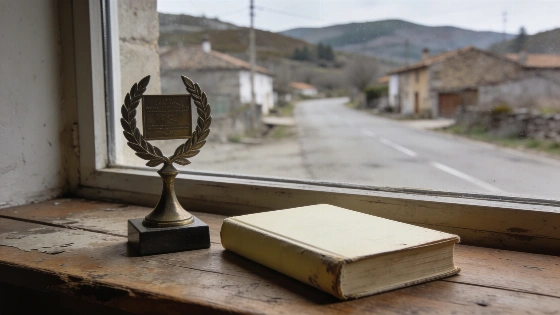
That earlier book made Llamazares widely known. It expanded the territory of Spanish narrative through its portrait of an abandoned village in the Aragonese Pyrenees after the death of its penultimate inhabitant. The setting became an anguished, poetic wasteland.
The same empty spaces return in El viaje de mi padre, but the gaze is different. The earlier lyricism gives way to a more accidental and playful route. Chance, memory and close observation shape the journey.
A review in La Lectura described this method as the work of a writer whose strongest talent does not always come through invention. It comes through watching and listening.
The award places Llamazares alongside recent National Narrative Prize winners such as Marilar Aleixandre, Xesús Fraga, Juan Bonilla, Pilar Adón, Cristina Morales, Almudena Grandes, Fernando Aramburu and Cristina Fernández Cubas. Last year's prize went to Paco Cerdà for Presentes, another work connected with the Civil War.
El viaje de mi padre was published by Alfaguara in autumn 2025. The timing gives the prize a clear place in Llamazares's career, rewarding a relatively new book while recognising decades of work.
His achievement is not only about one title. It confirms the value of a literary route in which geography carries history and family memory meets real places.
Precision does the work.
El viaje de mi padre earns its place without spectacle. The National Narrative Prize recognises the strength Llamazares has returned to throughout his career: turning overlooked landscapes into a clear record of what time has left behind.