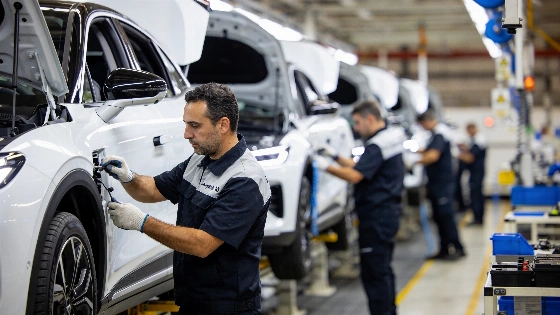
Leapmotor, backed by Stellantis, has posted a dramatic surge in profits and is set to begin manufacturing in Zaragoza. The move marks a major step in the company's global strategy as it navigates new trade barriers and rising costs.
Leapmotor, the Chinese electric vehicle manufacturer with Stellantis as a key shareholder, has closed the first half of 2026 with a striking leap in profitability and is preparing to start production in Spain. According to elespanol motor, the company reported a net profit of 208.4 million yuan (€26.5 million), nearly seven times higher than the same period last year. Attributed net profit also quadrupled to 178.2 million yuan (€22.7 million), while operating profit reached 128.4 million yuan (€16.3 million), a sharp turnaround from the operating loss recorded in early 2025.
This financial upswing is closely tied to a 60.8% jump in global sales, with 356,487 vehicles delivered worldwide in the first half of the year. International markets have become increasingly important for Leapmotor, as overseas sales soared to 96,294 units—almost five times more than a year ago. Exports now account for 27% of total sales, up nearly 18 percentage points from the previous year, reflecting a strategic pivot as the Chinese domestic market faces ongoing price wars and shrinking margins.
Chinese automakers are no longer just exporters — they are becoming European manufacturers, and Leapmotor's move into Zaragoza is a clear signal of that shift.
Revenue for the first half of 2026 reached 38.1 billion yuan (€4.86 billion), up 57.1% year-on-year. Notably, income from international markets grew sevenfold to 9.1 billion yuan (€1.16 billion), with Europe emerging as Leapmotor’s second-largest market after China. European revenues hit 8.88 billion yuan (€1.13 billion), nearly five times higher than last year and now representing 23.8% of total turnover. Meanwhile, Chinese domestic revenue grew by 30.1% to 29 billion yuan (€3.7 billion).
Leapmotor’s workforce has also expanded rapidly, with nearly 10,000 new employees added in six months. By the end of June, the company employed 31,388 people globally, most of them based in China.
Spanish Production Milestone
In a significant move for its European ambitions, Leapmotor is set to begin manufacturing outside China for the first time. The company has chosen Spain as its launchpad, with the Figueruelas plant in Zaragoza scheduled to start producing the Leapmotor B10 in the third quarter, likely in October. The facility has undergone necessary upgrades to accommodate the new model. Additionally, pilot production of the Leapmotor B05 is expected to begin this year, with full-scale manufacturing planned for 2027.
Stellantis, which acquired a 20% stake in Leapmotor after investing over €1.5 billion in late 2023, is also in talks to transfer ownership of its Villaverde plant in Madrid to the Chinese automaker. These moves are designed to help Leapmotor sidestep the 30.7% EU import tariff on Chinese-made electric vehicles, a challenge that has prompted several Chinese brands to localize production in Europe. This trend echoes broader shifts in the industry, as seen when Geely ramped up its export ambitions following its stake in Ford España.
Forecasts and Industry Context
Despite its strong results, Leapmotor has revised its net profit forecast for the full year downward, now expecting 3 billion yuan (€382.3 million) instead of the previously projected 5 billion yuan. The company attributes this adjustment to rising raw material costs. Looking ahead, Leapmotor anticipates overseas sales will reach 150,000 units by year-end, with a target of 350,000 to 400,000 vehicles abroad in 2027—50,000 of which are expected to come from Stellantis sales channels.
Industry analysts note that Leapmotor’s rapid expansion in Europe is part of a broader trend among Chinese automakers seeking higher margins and stability outside their home market. The company’s decision to localize production in Spain not only addresses tariff pressures but also positions it to compete more directly with established European brands. As the electric vehicle sector continues to evolve, Leapmotor’s next steps in Zaragoza will be closely watched by both competitors and policymakers.