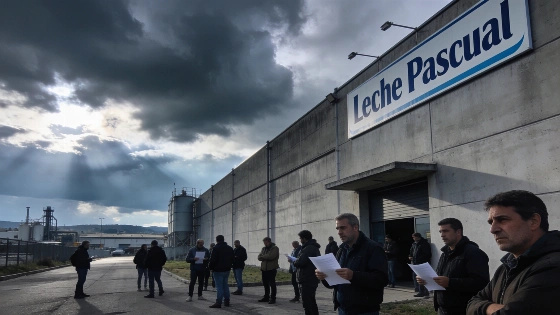
Leche Pascual has initiated an ERE for all 80 employees at its Gurb plant. The closure follows the sale to Casa Tarradellas, raising uncertainty over job continuity. Workers question the company's motives and future offers.
Leche Pascual has formally launched an expediente de regulación de empleo (ERE) that will affect all 80 staff members at its Gurb dairy facility in Barcelona province. The move comes just months after Casa Tarradellas announced it would acquire the plant to convert it for mozzarella production, a transition now shadowed by job insecurity and unresolved negotiations.
The closure of the Gurb site is scheduled for July 31, at which point Casa Tarradellas will take over operations. Despite initial assurances of continuity and individual job offers, talks between Leche Pascual and the workforce have failed to secure collective guarantees. Workers, represented by the Col·lectiu Ronda legal cooperative, remain skeptical about the prospects for employment under the new owner, especially as no binding group offer has been presented.
According to Col·lectiu Ronda, the ERE lacks a genuine economic or productive justification. The Gurb plant reportedly posted strong profitability and output in the previous year, contradicting claims of unviability. Worker representatives argue that Leche Pascual is shutting down a successful operation to shift production elsewhere, particularly to its Burgos facilities. This strategic shift had already become apparent months earlier, as machinery and production lines were gradually relocated from Gurb to Burgos.
The plant, which opened in 2004 after an investment exceeding €70 million, has seen a steady reduction in activity. Employees criticize Leche Pascual for delaying negotiations until most operations had already wound down and accuse the company of fostering vague hopes about Casa Tarradellas hiring the existing team. In recent months, Leche Pascual has also dismissed several workers individually, a move seen by staff as a sign of reluctance to negotiate collectively. Notably, eight employees were recently reinstated following disputes over these dismissals.
Leche Pascual, in its own statement, confirmed the ERE filing, stating that all alternatives for continuity had been explored and that the company aimed to protect jobs and provide certainty. The company noted that Casa Tarradellas had made individual employment offers matching current pay and seniority, but these have so far been declined by the workforce, who still have time to reconsider. The company also cited respect for a recent works council election as a reason for delaying the ERE process.
Negotiations over the ERE begin immediately, with Leche Pascual expressing a willingness to engage in dialogue to ensure the best possible outcome for affected staff and a smooth transition. The key unresolved issue remains whether Casa Tarradellas will absorb the current workforce or only a portion, as no collective agreement has been reached.
This development in Gurb highlights ongoing tensions in Spain's industrial sector, where plant closures and workforce reductions often spark disputes over the legitimacy of economic grounds and the adequacy of transition measures. The situation echoes broader debates about employment protections and company obligations, as seen in other recent cases such as the controversy over collaborator status in Zaragoza's mask procurement, detailed in this report on legal uncertainties in public sector contracts.
For context, Spain's ERE process is a legal mechanism allowing companies to lay off staff collectively under certain conditions, but it requires justification and negotiation with worker representatives. The outcome of the Gurb negotiations may set a precedent for similar transitions in the food industry, especially as consolidation and automation continue to reshape the sector. The case also underscores the importance of transparent communication and timely negotiation when major operational changes are planned.