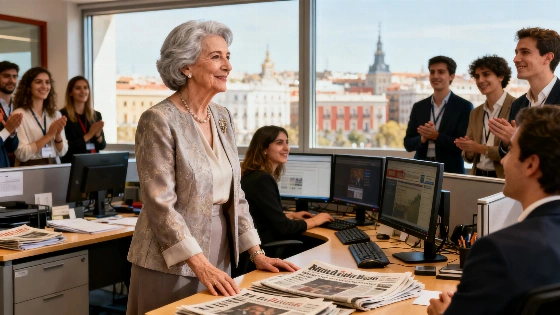
First Female Director of EL PAÍS and Symbol of Spanish Journalism Passes Away. Sol Gallego-Díaz, the first woman to lead EL PAÍS and a key figure in Spanish journalism, has died in Madrid at the age of 76. She became widely known for publishing the draft of the 1978 Constitution.
Sol Gallego-Díaz has passed away in Madrid — a journalist whose name became a symbol of professionalism and independence in Spanish media. She was 75 years old. At just 26, she published in the magazine Cuadernos para el diálogo the secret draft of the 1978 Constitution, which became one of the biggest journalistic sensations of the transitional period. This move not only revealed a crucial document to the public but also set a new standard of openness for the Spanish press.
Career path
Sol Gallego-Díaz went from correspondent to becoming the first female director of EL PAÍS, taking charge of the newspaper in 2018. She worked in Brussels, London, Paris, New York, and Buenos Aires, covering key international events including the collapse of the USSR and political changes in Europe. Over the years, she served as deputy director under three editors-in-chief, was a political columnist, editor, lecturer, and advocate for readers' interests.
In recent years, Gallego-Díaz wrote a weekly column in the Ideas app and collaborated with Cadena Ser. Her writing was marked by precision, conciseness, and respect for the reader: she never imposed her opinion but offered facts and arguments, prompting even the most experienced colleagues to reflect.
Ethics and principles
Gallego-Díaz was considered one of the main moral compasses for several generations of journalists. She repeatedly emphasized that the most important thing in the profession is teamwork and respect for standards. In 2018, while receiving the Ortega y Gasset Award, she noted that it is the editorial teams that make the media great, and that collaborating distinguishes quality journalism from superficial reporting.
In April, despite serious illness, she took part in the ceremony for the inaugural FAPE award for journalistic ethics. In her speech, Gallego-Díaz emphasized the journalist's right to refuse actions that conflict with professional principles, even if it involves risking their career. Early in her career she had already faced such a situation: in 1975 she was dismissed from the Pyresa agency for taking part in a strike—a step that became an example for many colleagues.
Personality and influence
Soledad Gallego-Díaz was born in Madrid in 1951 in a family with strong political traditions. Her father, a mathematician and a republican, had a significant influence on the formation of her views; however, her personal beliefs never prevented her from remaining objective. She did not seek patronage or focus on her status as the first woman in the profession, preferring to prove her competence through her work.
The publication of the draft Constitution was not only a professional achievement but also an example of civic responsibility. Together with her colleagues, she ensured that this crucial national document became accessible to the public, despite accusations of irresponsibility. This case demonstrated that for her, journalism is not just a job, but a tool for real change.
Руководство EL PAÍS и реформы
In 2018, Gallego-Díaz took over as head of EL PAÍS during a challenging period for the publication. She did not emphasize her appointment as a precedent but immediately carried out reforms: she renewed the editorial team, implemented a paywall system, and launched a large-scale investigation into cases of pedophilia in the Catholic Church. Under her leadership, the newspaper endured the pandemic, when the entire team worked remotely while access to information remained open to readers.
Within the team, Gallego-Díaz enjoyed exceptional trust: 97% of employees voted for her candidacy. She always stressed that the success of the publication depends on teamwork and respect for professional standards. Her leadership style was marked by restraint and attention to detail, allowing the newspaper to maintain its market position.
Legacy and Remembrance
After stepping down as director in 2020, Gallego-Díaz returned to journalism, continuing to influence the professional community. Her colleagues note not only her professionalism, but also her personal qualities: sense of humor, openness, and ability to support others in difficult times. As with other outstanding journalists, her memory will be associated with her principles and her willingness to stand up for her beliefs.
In Spanish journalism, Gallego-Díaz will remain an example for those who believe that the profession requires not only skill, but also inner integrity. Her approach to work and life echoes the values recognized in other cases of journalists being honored, such as during the presentation of the Premis Nacionals de Comunicació awards, which was recently reported at the ceremony in Sabadell.