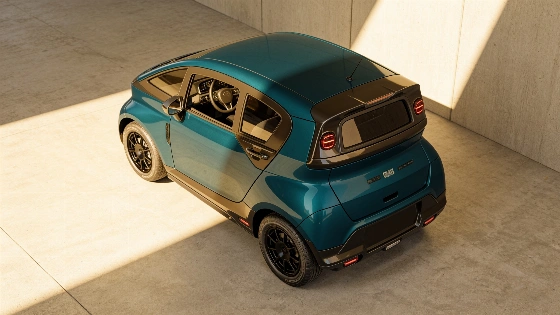
Nearly 7,500 people have already signed up for the Liux Big, an electric quadricycle set to reach Spanish city streets at a starting price below eighteen thousand euros. Liux aims to offer a lightweight, eco-friendly vehicle at a lower price with a smaller carbon footprint than regular electric cars.
The Big will be built in Azuqueca de Henares, Guadalajara, and is scheduled to make its official debut at the Paris Motor Show. Mondial de l’Auto organizers say the public will see it from October 12 to 18, 2026, as an L7e light quadricycle. Several independent sources say it will have a maximum nominal power of 15 kW and reach speeds of up to 90 km/h. In France, drivers as young as 16 can lead it with a B1 license. Battery options of 15 and 20 kWh are expected to provide a WMTC-certified range of about 210 to 270 km. The vehicle, including its battery, weighs 648 kilograms, information from official Paris Motor Show materials.
The Big has an ultralight monocoque body made entirely from flax fiber biocomposites. Company data say this reduces weight by 40 percent compared with a steel chassis and cuts CO2 emissions by 60 percent. The car’s energy use is 6.7 kWh per 100 kilometers, making it one of the most efficient in its class. These figures come from the company; several industry publications note they have not yet been independently verified.
Charging is designed to be simple. The 3.3 kW onboard charger takes the battery from 20 to 80 percent in under three hours using a regular household outlet. The two-seat interior pairs a digital instrument panel with a multifunction steering wheel, while large, easy-to-use controls keep operation straightforward. It is simple and practical, aimed at city drivers who want efficiency without extras.
Liux plans to sell the Big in Spain, with Italy and France also among its target markets. Deliveries are set to begin in the first half of 2027. Independent Spanish and French media have reported the schedule and target markets. The new Guadalajara plant is expected to reach a production rate of 20,000 units per year from 2028. Liux is ready to ramp up if demand remains strong.
Interest in the Big is growing, as a recent report on early reservations shows. Liux is positioning the Big to compete directly with established brands in the city EV market, combining its price and range with sustainable materials.
Lightweight construction and biocomposites remain rare in mass-market electric cars, which usually use heavier steel or aluminum frames. By focusing on efficiency and keeping costs down, Liux is betting that city drivers will prioritize practical range and low running costs over power or luxury. Production ramp-up and the first cars on the streets will put that bet to the test.