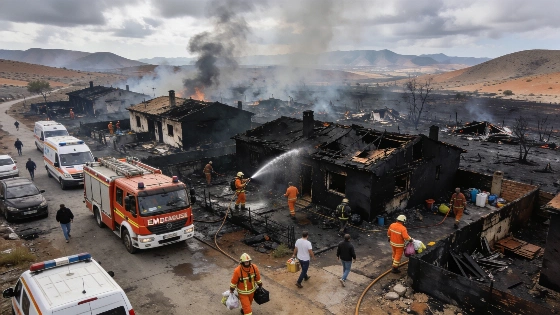
The Los Gallardos wildfire in Almería, which killed 12 and forced 1,000 evacuations, is now stabilized. Authorities credit improved weather and emergency response. Residents are being allowed to return as the situation de-escalates.
Authorities in Andalusia have confirmed that the devastating wildfire in Los Gallardos, Almería, has been stabilized after burning through 7,000 hectares and claiming 12 lives. The announcement came from Juan Manuel Moreno, president of the Junta de Andalucía, who visited the advanced command post in Turre on Sunday morning. He emphasized that the fire, described as the worst in the region’s recent history, is no longer spreading, and expressed confidence that no further fatalities will be discovered.
With the situation under control, the 1,000 residents who were evacuated due to the rapid advance of the flames are now permitted to return to their homes. The fire, which at its peak moved at a rate of 100 meters per minute, forced authorities to act quickly to protect local communities. Improved weather conditions, including high humidity and calmer winds since Saturday, allowed officials to lift confinement orders in several affected areas overnight. The return of residents began with 600 people and is now being extended to all those displaced.
The response to the wildfire involved a significant deployment of resources. At the height of the emergency, more than 500 personnel and 23 aerial units were engaged in firefighting efforts, supported by the Unidad Militar de Emergencias (UME). With the fire now stabilized and the emergency level downgraded to operational status 1, the UME is concluding its work in the area. President Moreno publicly thanked the military for their commitment and effort during the crisis. Defense Minister Margarita Robles is scheduled to visit the troops who have been on the ground since Thursday night, working to contain a fire perimeter that reached 40 kilometers.
Efforts are now focused on fully controlling and extinguishing the remaining hotspots, with 90 Infoca firefighters still active in the region. The process of identifying the 12 victims continues, as authorities report that DNA analysis has proven challenging due to the nature of the incident. The Guardia Civil remains on site, conducting searches to ensure no additional casualties are found. Moreno noted that, to his knowledge, all residents received personal warnings about evacuation and safety measures, and he praised the efforts of local officials, particularly the mayor of Los Gallardos, Ángel Collado.
Investigators are still working to determine the exact cause of the fire. The leading theory points to the breakage of an electrical cable near a roadway, but the final conclusion will depend on the outcome of a judicial investigation now underway. Moreno highlighted the increasing complexity of wildfires in Andalusia, attributing the trend to climate change and the region’s challenging terrain and weather patterns. He warned that the summer season has only just begun, with the region already experiencing an average of 15 fire outbreaks daily, and up to 22 on some days.
The Los Gallardos tragedy follows a series of deadly incidents in the area. As previously reported, a fast-moving blaze in Almería led to the deaths of 12 people, many of whom were foreign residents caught in dangerous conditions. For more on the circumstances that contributed to the high casualty count, including evacuation challenges faced by local and foreign residents, see this detailed account: how evacuation route errors turned deadly in Los Gallardos.
Wildfires remain a persistent threat in southern Spain, particularly as climate conditions evolve. The Los Gallardos incident underscores the importance of rapid response, clear communication, and ongoing adaptation of emergency protocols. With the fire now stabilized, attention turns to recovery, investigation, and the continued vigilance required as the summer progresses.