A fast-moving wildfire in Los Gallardos, Almería, claimed at least 12 lives, mostly British and Belgian residents. Many died after taking a dead-end escape route. Over 1,100 people were evacuated as authorities battled the blaze.
At least twelve people, most of them British and Belgian nationals, lost their lives in Los Gallardos (Almería) after a wildfire swept through the Sierra de Bédar, turning a rural escape route into a fatal trap. The victims, caught by flames while fleeing on foot or by car, became stranded in a dead-end ravine as the fire advanced rapidly, fueled by strong winds and parched vegetation. Emergency services described the area as a labyrinth, with narrow, unmarked paths and scattered homes complicating evacuation efforts.
The blaze erupted on Thursday afternoon, reportedly triggered by a broken private power line near kilometer 511 of the N-340 A, close to the hamlet of Almocáizar. Within hours, gusts of up to 50 km/h drove the fire up the hillsides, consuming dry grass and brush left brittle by two intense heatwaves. Local authorities, including the mayors of Los Gallardos and Bédar, began door-to-door warnings, instructing some residents to evacuate and others to shelter in place, depending on their location. However, not all heeded the advice, and some attempted to escape via unapproved routes, leading to the tragedy.
Among the deceased were several expatriates who had chosen the Sierra de Bédar as a retirement haven. The area, dotted with old farmhouses and isolated dwellings, is home to hundreds of foreign retirees. As the fire raged, confusion over evacuation instructions and the region’s complex terrain left two groups of residents trapped. In addition to the fatalities, eight people suffered serious burns, with four airlifted to the burns unit at Hospital Virgen del Rocío in Seville.
By Friday, more than 1,150 people had been evacuated from affected villages, including Los Burgos, Los Villaltas, and a local campsite. Many found shelter with relatives, while others were housed in the Garrucha sports hall. Firefighters, supported by the military and mountain rescue teams, continued to search burned-out homes for further victims, as some areas remained too dangerous to access. The Guardia Civil began collecting DNA samples from families searching for missing persons, with three official disappearance reports filed by the end of the day.
Authorities reported that the fire had already scorched over 4,000 hectares and destroyed numerous homes, though the exact number remained unclear. The president of the Junta de Andalucía described the incident as the most severe wildfire in the region’s history, noting that the flames advanced 15 kilometers in just two hours. The decision not to use the Es-Alert mobile warning system was based on the need for tailored instructions, as evacuation or confinement orders varied by address.
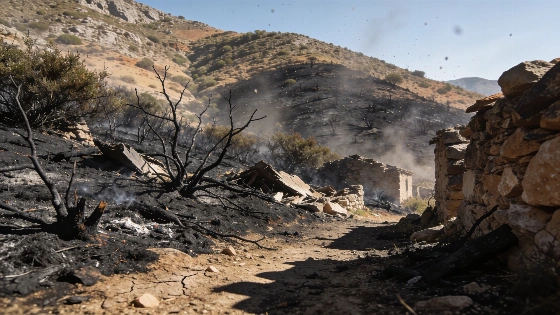
Scenes from the aftermath revealed charred vehicles, melted metal, and the lingering smell of burnt rubber along the dirt track where the failed escape occurred. One of the cars, a right-hand-drive Honda Accord with Spanish plates, underscored the international makeup of the victims. Emergency officials confirmed that the group had used a route not recommended by authorities, which ended in a cul-de-sac, leaving them with no way out as the fire closed in.
Efforts to control the blaze continued into the night, with aerial units focusing on the western front and controlled burns used to halt its advance toward the A-7 motorway. The forecast for calmer winds offered some hope for containment. Meanwhile, the Institute of Legal Medicine in Almería completed autopsies on the twelve victims, but identification was delayed due to the condition of the remains. Biological samples were flown to Madrid for analysis by the Guardia Civil’s forensic department.
This tragedy in Almería follows a series of deadly incidents across Spain this summer, highlighting the growing risks posed by extreme weather and challenging terrain. In a related context, the dangers of sudden emergencies in tourist and expatriate areas were underscored earlier this season when a fatal yacht accident off Xàbia claimed the life of a 35-year-old tourist, prompting renewed calls for improved safety protocols in high-risk zones.
Spain’s wildfire season has become increasingly severe in recent years, with climate factors and rural depopulation complicating prevention and response. The Sierra de Bédar incident stands as a stark reminder of the importance of clear evacuation planning and the dangers of underestimating fast-moving fires in isolated communities.