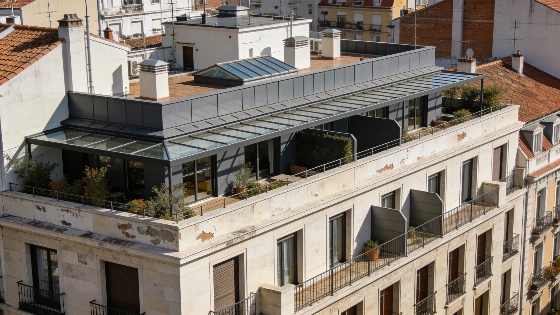
A confidential government dossier on a €6.3 million penthouse in Chamberí exposes a series of inconsistencies in its acquisition, rental, and attempted sale. The case raises pressing questions about oversight and transparency in Madrid’s management of public assets.
Months before any official justification was provided, the public company Planifica Madrid had already committed millions to a luxury penthouse on paseo del General Martínez Campos. The 224-page official dossier details a chain of decisions that bypassed standard procedures and left key questions unresolved.
The controversy centers on a €6.3 million purchase that proceeded without documented need, prior authorization, or clarity on the property’s legal status. According to the dossier, Planifica Madrid signed a confidentiality agreement on February 3, dispatched a valuer on February 11, and paid a €630,000 deposit by the end of the month—all before any formal rationale for the acquisition was recorded. The first official explanation for the penthouse’s necessity appeared only on July 2, more than four months after the deal was finalized. RTVE reports that the purchase was completed on April 14, 2026, with Planifica Madrid registered as sole owner two days later—a pivotal moment in the ongoing dispute.
The attempted resale of the penthouse in 2026 failed to attract a single valid bid, despite an initial asking price of €6.69–6.7 million.
Urban planning issues were overlooked. The valuation report noted that part of the terrace had been enclosed and altered without proper registration, yet Planifica Madrid accepted the property “as is,” waiving any requirement for correction or municipal consultation. The official deed explicitly states that the urban status was not verified. The dossier contains four different measurements of the property’s size, ranging from 481 to 500 square meters, with no attempt to reconcile these figures. Multiple independent reports, including those cited by RTVE, confirm the area is approximately 485 m², consistent with the official rationale that the space was intended for work and occasional accommodation of authorities. However, doubts about the necessity of the purchase persist.
Further contradictions emerge in the documentation. Legal and budgetary reports are dated inconsistently, with some apparently signed before the documents they reference existed. The official plan described the penthouse as a residence for work and occasional accommodation of authorities but did not specify who would use it or what modifications were planned. Planifica Madrid certified the property’s compliance with urban regulations but cited no legal articles, licenses, or municipal input. Madrid government advisor Miguel Ángel García Martín stated that the property was acquired not as a personal residence for Ayuso, but for "institutional use" and to provide support during renovations at the Real Casa de Correos.
The rental arrangement added further confusion. The Presidency agreed to lease the penthouse for ten years at €3,000 per month—well below market value—with a 15-month rent-free period. Yet just 46 hours after the contract was signed on July 27, the Presidency ordered the cancellation of the financial document, without explanation for the sudden reversal.
The case is now under dual scrutiny: a criminal investigation in Madrid’s Court No. 8, where the judge has asked prosecutors to clarify the court’s jurisdiction, and a parallel review by Spain’s Court of Auditors. Both probes focus on potential procurement violations and abuse of office, raising the stakes for the regional government.
Even before the rental contract was formally terminated, the process to sell the penthouse began. The board approved the sale on August 5, and the procedure started two days later, before the rental agreement was officially dissolved. The sale process was opaque: there was no visible valuation, no economic reports, no property visits allowed, and not a single offer was received. The lot was declared deserted. According to El Constitucional and RTVE, the failed sale has only increased scrutiny of the government’s handling of the asset.
Throughout, Isabel Díaz Ayuso, president of the Community of Madrid, has maintained she never intended to use the penthouse as a personal residence. Yet the official record is marked by gaps, contradictions, and missing documentation at every stage—purchase, rental, and attempted sale. The absence of a clear need, lack of transparency in pricing, and disregard for urban planning norms highlight a system where oversight appears more theoretical than practical. Opposition parties, including PSOE Madrid, have seized on the controversy, demanding explanations and, in some cases, Ayuso’s resignation, making the penthouse saga a persistent political issue.
This case starkly illustrates how public property management can slip into a grey area when basic controls are ignored. While the dossier does not resolve the central mysteries surrounding the penthouse, it exposes a pattern of decision-making that erodes confidence in institutional accountability. For Madrid’s citizens, the unanswered questions extend beyond one luxury apartment—they concern the standards expected from those entrusted with public assets.