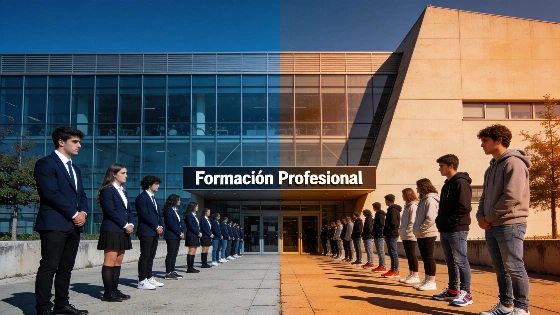
Madrid now leads Spain in vocational education privatization. More than half of students are in private centers. Over 60,000 young people were left without a public place for 2024–2025, raising concerns about access and cost.
Madrid has become the first region in Spain where the majority of vocational education students are enrolled in private institutions. According to a report by Comisiones Obreras, 50.59% of those studying Formación Profesional (FP) in Madrid now do so at private centers. The union highlights that more than 60,000 young people were unable to secure a public place for the 2024–2025 academic year, pointing to a growing gap in access to affordable vocational training.
The surge in demand for FP has been significant. Between 2018–2019 and 2024–2025, total enrollment in Madrid increased by over 85%, adding nearly 83,000 students. However, the expansion of public places has not kept pace. While public FP enrollment grew by 58%, private enrollment more than doubled, rising by 122%. As a result, the share of students in public vocational programs dropped below 50% for the first time in recent history, according to the union's findings.
Comisiones Obreras argues that the regional government, led by Isabel Díaz Ayuso, has deliberately limited the growth of the public FP network. The union claims this has turned access to vocational education into a privilege determined by income and location. The report notes that the most in-demand courses—such as Diagnostic Imaging, Radiotherapy, Dental Hygiene, Web Application Development, Early Childhood Education, and Social Integration—are often missing from the public offering but widely available in the private sector.
Cost is a major barrier for many families. The union estimates that attending a private FP center in Madrid can cost between €3,000 and €6,000 per year for higher-level courses, with specialized programs reaching up to €16,000. Average family spending on higher-level FP has doubled in seven years, from €1,069 in 2016 to €2,085 in 2023. This financial burden, combined with limited public options, has made vocational training less accessible for lower-income households.
The growth of online FP programs has further accelerated privatization. The number of students enrolled in distance learning in Madrid jumped by 492% over the period studied. Private online FP grew more than six times faster than its public counterpart, especially at the higher levels. The number of private centers offering online higher-level FP nearly quadrupled, from 28 to 102. The union warns that this expansion has occurred in a largely unregulated environment, with some private providers offering bundled degrees or combined university programs, and with significant differences in graduation rates between public and private online centers.
Madrid's business landscape also complicates the implementation of the new dual FP model, which requires students to combine classroom learning with mandatory company placements. With 94.6% of Madrid's half a million businesses being sole proprietors or microenterprises, the union argues that it is difficult to guarantee quality, supervised internships—especially in public centers. There are concerns that, without strict oversight, the dual model could become a source of cheap labor or even replace regular jobs.
Gender disparities persist in vocational training. In 2023–2024, only 8,840 students in Madrid were enrolled in Dual FP, and just 4.41% were women. The report also highlights a lack of guidance for students, with only 3.8% of female students saying they received sufficient information about FP options, compared to 14.2% of male students. Only 16.27% of women enrolled in Madrid's FP programs chose STEM fields, which typically offer better pay and job security.
Comisiones Obreras is calling for urgent structural measures to reverse the privatization trend. The union proposes a multi-year plan to systematically eliminate waiting lists for public FP places, with stable funding and a focus on territorial and social equity. It also demands a national framework for online FP to ensure consistent quality standards, real supervision, transparent evaluation, and stronger inspection. For the dual model, the union wants safeguards against job substitution, recognition of tutor hours, protection of student rights, and real supervision in companies.
Across Spain, vocational education has shifted from being a secondary choice to a preferred path for many young people, largely due to its high employability. According to the report, 68.6% of the population views FP positively, rising to 74% among those who have completed it. However, the Madrid case illustrates how rapid growth in demand, combined with limited public investment, can lead to increased privatization and new barriers to access. In contrast, regions like the Canary Islands and Castilla-La Mancha maintain much lower rates of private FP enrollment, suggesting that alternative models are possible. The debate over the future of vocational education in Spain continues, with access, affordability, and quality at the center of the discussion.