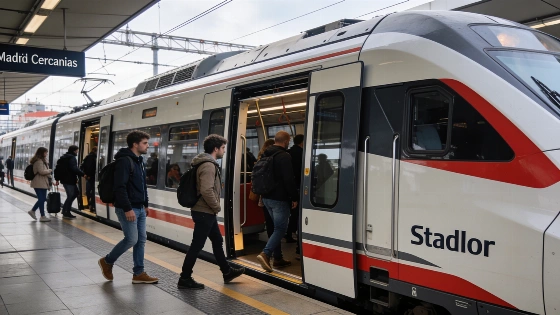
Renfe has started operating new Stadler trains in Madrid. Each can carry nearly 2,000 passengers. The move aims to ease overcrowding during peak hours and modernize the Cercanías network.
Madrid’s Cercanías network is undergoing its most significant upgrade in decades as Renfe rolls out new Stadler trains designed to handle the city’s intense commuter demand. The first of these high-capacity trains, each stretching up to 200 metres and accommodating up to 1,884 passengers, began service this week. The initiative, presented at Príncipe Pío station by Transport Minister Óscar Puente and Renfe president Álvaro Fernández Heredia, marks a major step to relieve pressure on a system that moves around 730,000 people daily.
The deployment is part of a €1.3 billion investment that will see 79 Stadler units gradually integrated into the Madrid network. Two trains are already in operation, with 17 expected by year’s end. The new fleet is split between T100 models, offering 912 seats, and the larger T200s, which surpass previous capacity records for Renfe’s single-composition trains. According to Puente, these trains are tailored for peak times, providing about 20% more space than the Civia models introduced over 20 years ago.
Beyond sheer size, the Stadler trains bring practical improvements: more doors, wider access points, and redesigned vestibules to speed up boarding and reduce station dwell times. These changes are intended to improve punctuality across the network, where even a few seconds saved per stop can have a significant impact. The C-5 line, which alone accounts for 16% of Renfe’s national commuter traffic, is set to benefit most. To accommodate the longer trains, the Ministry will extend platforms and implement the ERTMS European traffic management system, enhancing both safety and operational efficiency.
Passenger comfort and accessibility are also central to the upgrade. The new trains feature dedicated spaces for wheelchairs, strollers, bicycles, and luggage, as well as onboard video surveillance, USB ports, LED lighting, Wi-Fi, and advanced climate control. Real-time occupancy data will be available to passengers, and communication systems allow for direct updates in case of disruptions. Notably, the trains are equipped with emergency batteries, enabling them to travel up to four kilometres without external power—minimizing the risk of passengers being stranded between stations.
The arrival of the Stadler fleet allows Renfe to redistribute existing Civia trains to other regions, including Valencia. This move has sparked debate, with some local politicians criticizing the transfer of used trains. The Ministry maintains that the Civia units remain among the most modern in service and will be refurbished as needed. The strategy, officials argue, is to match train types to local demand, with Madrid receiving the highest-capacity models and other cities benefiting from the released stock. As seen in other recent transport updates, such as the Ibiza taxi enforcement case, authorities are under pressure to adapt infrastructure and services to shifting mobility patterns.
Spain’s investment in new rolling stock is part of a broader national program exceeding €4 billion for around 400 trains. This is the largest procurement of its kind in the country’s history, reflecting the scale of demand in urban centres like Madrid. The upgrades are expected to ripple across the network, gradually improving service quality and capacity in other regions as well. For Madrid’s commuters, the immediate impact will be felt in shorter waits, less crowding, and a more modern travel experience—an overdue response to years of rising passenger numbers and infrastructure strain.