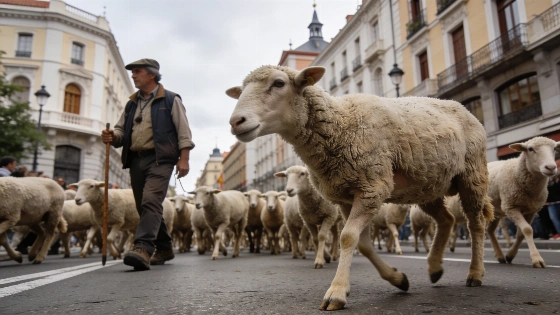
Madrid’s transhumance festival is set for Sunday 25 October, with 1,250 sheep and 160 goats taking an alternative route because of the camp in Puerta del Sol. The flock will bypass Sol and Cibeles this year.
At Plaza de la Villa, shepherds are due to make a symbolic payment to Madrid after the flock crosses the city centre. The XXXIII Fiesta de la Trashumancia is set for Sunday 25 October. Because of the encampment in Puerta del Sol, 1,250 sheep and 160 goats, 1,410 animals in total, will follow an alternative route. The municipal reception is scheduled there between 11:15 and 11:25 a.m.
The animals will not pass through Puerta del Sol or reach Plaza de Cibeles and the City Hall. Madrid City Council has set a different itinerary to keep the procession moving around the camp, which has occupied the square since late September. The route starts at Casa de Campo, then runs via Puente del Rey, Cuesta de la Vega, calle del Duque de Nájera, calle Mayor, Plaza de la Villa, Plaza Mayor, calle de Toledo, Plaza de la Cebada, Carrera de San Francisco and calle de Bailén before turning back toward Casa de Campo. The encampment has also raised concerns about nearby shops’ Christmas trade, as retailers’ accounts have shown.
The route links Cuesta de la Vega with calle Mayor and also passes calle de Bailén. Plaza de la Villa and Plaza de la Cebada are among its other named points. Each year, the passage takes livestock through basic streets to draw attention to historic drovers’ roads and transhumance’s role in maintaining cultural landscapes. Madrid’s weekend programme, running from 23 to 25 October, also features activities on artisan cheese, wool and the cultural significance of transhumance.
On 21 October, the Community of Madrid’s Council of Government approved declaring transhumance a Bien de Interés Cultural (BIC) in the category of intangible heritage. The regional government describes it as the seasonal movement of sheep, goats and cattle between areas with more favourable pasture and climatic conditions. It says the tradition has shaped architectural, ethnographic and sector heritage, including shepherds’ shelters and livestock enclosures such as chozos, tinados, casetas, corrals, majadas, apriscos and toriles. The declaration also recognises the network of livestock routes, including cañadas reales, cordeles, veredas and coladas. UNESCO added transhumance to its Representative List of the Intangible Cultural Heritage of Humanity in 2023.
This form of pastoralism moves livestock between winter and summer pastures. In Spain, its history is closely tied to the Honrado Concejo de la Mesta, a powerful association of livestock owners from León and Castile founded by Alfonso X in 1273. The king regulated and protected grazing routes known as cañadas reales. Four of those routes pass through the Community of Madrid. The regional government also identifies the Cañada Real Segoviana, which runs north to south through the region, as well as routes including the Leonesa Oriental and the Vereda de la Canaleja.
Since 1994, the Fiesta de la Trashumancia has advocated for extensive livestock farming, citing its contribution to biodiversity and the fight against climate change. Pastures cover more than half of the Earth’s surface and help limit the spread of major fires. The practice also carries rural customs and food traditions between regions. The city’s educational programme includes a welcome walk, spinning and felting workshops, wool demonstrations, storytelling and an exhibition on transhumance as intangible world heritage. Activities are scheduled at the Casa de Campo Environmental Information and Education Centre and the Dehesa de la Villa centre through 30 December.
At the Plaza de la Villa ceremony, shepherds and livestock owners are due to pay the city 50 maravedíes for every thousand head. The gesture recalls the Concordia of 1418, a medieval agreement that guaranteed flocks the right to cross the town’s territory. The city’s programme lists the traditional symbolic payment as 50 maravedís.