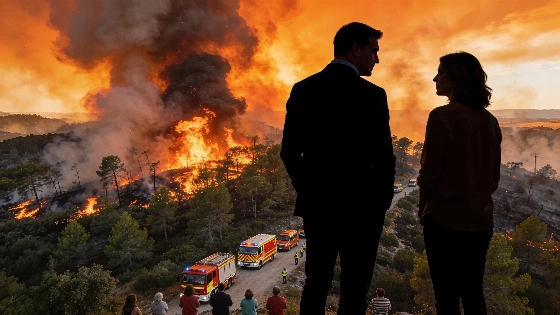
A severe wildfire in Madrid’s southern sierra pushed the central government and the regional administration to set aside their disputes and coordinate efforts on the ground. On Saturday morning in Cenicientos, Pedro Sánchez, Spain’s prime minister, and Isabel Díaz Ayuso, president of the Community of Madrid, met at the emergency command post. Their notably cool greeting came shortly before the site had to be evacuated as the flames advanced.
The emergency had already crossed regional and provincial boundaries. The fire began on 22 July near Burgohondo in Ávila, where sparks from heavy machinery ignited vegetation. Strong winds then drove its rapid spread. By 26 July, it had joined fronts near Almorox in Toledo and San Martín de Valdeiglesias in Madrid. On 25 July, Sánchez described the situation as complex and said the Military Emergency Unit would treat the Madrid and Ávila fires as a single operation. Spain declared an emergency covering the Community of Madrid and Ávila province as the response outgrew local boundaries.
Despite recent public clashes, including a heated exchange between Ayuso and Transport Minister Óscar Puente over emergency management and Madrid’s request for a national emergency declaration, both leaders refrained from criticism in their statements. Asked about the confrontation, Ayuso declined to comment further and acknowledged the need for joint action given the scale of the fire. Sánchez renewed his call for a “state pact on the climate emergency,” linking the growing intensity of wildfires to climate change. Governance disputes remained, though coordination across jurisdictions took priority during the emergency.
TVE footage showed local residents in Cenicientos urging Ayuso to prioritize firefighting over political disputes. The government’s delegate in Madrid, Francisco Martín, who had earlier criticized the regional administration’s decision to hand over control, also chose not to revisit the issue during the emergency. The previous day, Ayuso and Puente had exchanged personal insults during their disagreement. Opposition leader Alberto Núñez Feijóo, attending Galicia’s regional holiday in Santiago de Compostela, called for a more constructive political climate and cooperation among levels of government. Vox leader Santiago Abascal, by contrast, blamed the national government for the fires and linked them to what he called “climate fanaticism” and “corruption.”
The emergency grew far beyond the initial evacuations. About 11,500 people had been evacuated at an early stage, including more than 10,000 in Madrid and around 1,500 in Ávila. Later, more than 60,000 people were evacuated as the connected fires spread. The combined blaze ultimately burned approximately 63,000 hectares, came within 35 kilometers of Madrid, and destroyed homes and farms, along with restaurants and sports facilities. Reuters reported that the final hotspots were extinguished on 3 October. Separately, the Sierra Oeste fire was reported to have burned more than 29,000 hectares. Ecologist Fernando Manzano attributed its exceptional spread in part to continuous vegetation after years of declining grazing.
The disaster unfolded during a severe national wildfire season. EFE Verde reported that fires burned nearly 280,000 hectares of forest across Spain in 2026, about 2.5 times the average for the previous decade. In Madrid, controlled grazing covered 5,652 hectares during the year, while 81% of recorded fires remained below one hectare. The contrast showed how a small number of fires can escalate rapidly when severe conditions meet continuous vegetation fuel. The regional government later distributed nearly 500,000 kilograms of fodder and announced 43 urgent reconstruction measures for affected areas. The emergency temporarily overrode political divisions in Cenicientos, while disagreements over responsibility and over prevention and preparedness remained unresolved.