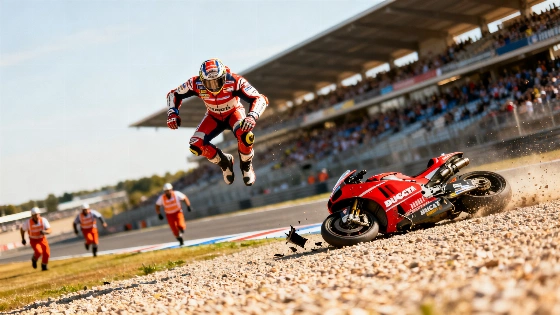
Marc Márquez has brought renewed focus to Ducati in the MotoGP paddock, calling the Italian machine “one of the best, if not the best, to fight for a World Championship.” His assessment reflects his view of what it takes to win at the highest level of motorcycle racing, and why even elite riders depend on a competitive package.
In a 2026 interview reported by Estadio Deportivo, Márquez said riders can achieve results with a good motorcycle, but even Jorge Martín or Fabio Quartararo, or Márquez himself, cannot overcome a deficient bike. The point reinforces his broader argument that championship outcomes depend on both rider ability and machinery.
For Márquez, a championship depends on more than raw speed. Consistency and flexibility separate champions from contenders. Solving problems on difficult weekends matters, too. Since joining the Ducati camp, the eight-time world champion has stressed the importance of a “complete” bike, one that delivers on favorable tracks and limits losses when conditions are less than ideal.
He sees Ducati’s technical foundation as a basic advantage. The Desmosedici pairs top-end speed with strong traction. Its stability under braking and flexibility across riding styles add to the package. Ducati’s competitive depth is also visible in its grid results: in a San Marino Grand Prix qualifying session, the manufacturer reported that two of its bikes were on the front row and four were among the top five. The spread included factory and satellite entries, illustrating the reach of the manufacturer’s operation beyond its works team.
Ducati’s recent MotoGP strength rests on ongoing technical development and a structure that can place multiple bikes near the front. Márquez’s own results offer another measure of the package’s potential: Speedweek reported that, in the title-winning season it covered, he recorded 11 Grand Prix victories and 14 sprint wins aboard a Ducati Desmosedici.
That versatility matters in a championship battle. A bike that works for different riding profiles has clear value, Márquez notes. His message is that Ducati is ready to fight for the title, and that he intends to be part of that effort. In 2026 comments reported by Crash.net, he said Ducati was “working, trying new things and giving everything” to challenge for the championship.
Consistency remains central to his thinking. Championships are often decided by the points salvaged on difficult weekends, not only by spectacular victories. Ducati’s broad competitive window, the ability to perform across a range of circuits and conditions, helps explain why Márquez regards it as a leading contender. That does not mean the Italian manufacturer is fastest everywhere: Márquez has also acknowledged that Aprilia was significantly quicker at particular circuits during the 2025 season.
Technical development is part of that contest. Defending Ducati’s willingness to examine ideas used by rivals, Márquez told Crash.net: “You cannot be arrogant and only [use] your ideas. Sometimes you can learn from the others, sometimes the others can learn from you.” His remarks frame MotoGP engineering as an ongoing exchange of concepts, shaped by rider feedback and competition, rather than a fixed advantage.
By publicly backing Ducati as a genuine title contender, Márquez raises expectations for himself and his team while signaling that the Italian marque has a proven platform. The evidence of multiple Ducati bikes at the front of a grid and Márquez’s reported wins supports that confidence, while rival performances show that the competitive balance can shift from circuit to circuit.
For Márquez, whose career has been defined by a relentless winning mentality, aligning himself with Ducati’s technical project is both a strategic and personal move. It places him within a structure capable of fighting for championships without diminishing his own ambitions.
As the season unfolds, Márquez’s belief in Ducati’s capabilities will be tested by MotoGP’s demanding schedule. His comments underline the importance of the technical base in modern Grand Prix racing: talent is impressive, but machinery is decisive. In his view, Ducati offers a strong chance to contend for the championship, provided the team continues to adapt as its rivals develop.
In recent years, Ducati has established itself as a benchmark for technical development and competitive consistency in MotoGP. Its ability to evolve, along with the depth of its teams and riders, has made it a leading title contender. Márquez’s endorsement adds weight to that reputation while leaving room for rivals to challenge at individual events.