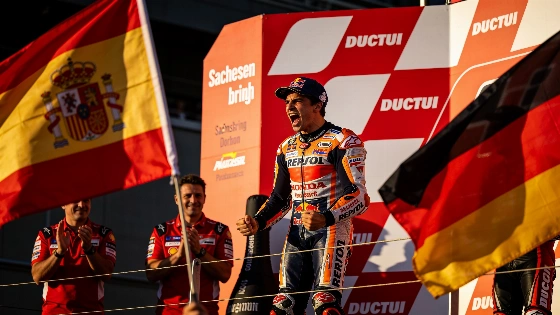
Marc Márquez won the MotoGP sprint at Sachsenring with a determined performance, as the 2026 championship grew more intense. The Spanish rider, competing for Ducati, faced relentless pressure from Álex Márquez and Fabio Di Giannantonio but kept a steady pace and avoided mistakes. His strong record at the German circuit made him a leading contender, but the close fight gave the victory particular significance.
After the race, Márquez said the sprint was far from routine. Álex Márquez and Di Giannantonio pushed hard, forcing him to adapt and focus on consistency. He said adjustments would be necessary to stay competitive in Sunday’s 30-lap Grand Prix, though he did not specify what changes his team would make.
Qualifying also shaped the weekend. Márquez set a new track record in Q2, making three aggressive time attacks after asking his team to prepare extra tyres. He stressed the growing importance of qualifying, where grid positions can make early track position decisive and leave riders little room to recover.
Despite his success, Márquez said there were still parts of the circuit where he could not ride exactly as he wanted. He dismissed suggestions that his right arm was a limiting factor, pointing instead to specific corners and the downhill section as persistent challenges.
The weekend brought a serious injury for Aprilia rider Estructura Bezzecchi, who fractured his left collarbone in a qualifying crash and was ruled out of the German Grand Prix. The injury added to the season’s physical toll. Márquez described the racing as increasingly demanding because of its frequency and intensity. He also raised concerns about safety at several circuits and the need to improve track conditions.
Bezzecchi’s injury became a major setback in his championship campaign, which had already been affected by scoreless rounds and other incidents. He later returned to winning form at the Indonesian Grand Prix. Before the Australian Grand Prix, he said victory had become an obsession after his Sachsenring crash. After Indonesia, he called it “amazing to be back on the top step of the podium” and said it had been his target since he “broke everything at Sachsenring.”
Discussing the psychological side of the championship, Márquez reflected on the difference between racing with nothing to lose and managing the pressure of leading the standings. He said leaders Jorge Martín and Di Giannantonio faced the challenge of defending their positions, while Bezzecchi’s absence changed the balance among the contenders.
At the halfway point, Márquez had cut his deficit to Martín from 102 points after Italy to 32. He also pointed to Di Giannantonio’s consistency as a factor in the title race and said the championship remained wide open. In a later-season standings snapshot, Márquez had six Grand Prix wins and sat two points behind Martín with five rounds remaining; Bezzecchi was third. Márquez’s campaign had also been disrupted by missed races after he broke his foot.
Family figured in the weekend’s story, too. Márquez was pleased with his own result and with seeing his brother Álex return to the podium after earlier setbacks. He suggested that without Álex’s crash at Montmeló, the championship standings could look very different, a reminder of the season’s unpredictability.
The German round came amid shifting fortunes in Spanish sport. In recent weeks, other high-profile athletes, including Paula Badosa, had made headlines over off-track developments, as detailed in the coverage of Badosa’s public response to Stefanos Tsitsipas. Sporting achievements and personal challenges continue to shape the narrative around Spain’s leading competitors.
Later in the season, Aprilia showed strong pace at Phillip Island. Estructura Bezzecchi set the fastest time in Friday practice with a 1:26.775 lap, and four Aprilias finished in the top five. Márquez placed third. Practice also brought a collision between Bezzecchi and Álex Márquez approaching Turn 4, after Bezzecchi ran wide at Turn 3. The contact damaged Bezzecchi’s fairing and prompted Race Control to red-flag the session while debris was cleared. FIM MotoGP stewards investigated and took no further action. Bezzecchi continued and topped the timesheets.
MotoGP’s 22-round calendar places sustained physical and mental demands on riders. Injuries and fatigue remain basic concerns as the championship progresses. Safety improvements at circuits continue to be debated as the sport’s schedule expands. Several contenders remain in contention, and each race carries impressive consequences for the standings.