Before becoming a symbol in Spain’s housing debate, Maricarmen Abascal faced her own property crisis. A mortgage default on a chalet in the Sierra de Madrid led to a court-ordered foreclosure, raising questions about her personal history amid her public fight for tenant rights.
Maricarmen Abascal’s name is now tied to Spain’s housing rights movement. But her own real estate story started long before the headlines. Years back, she lost a chalet in the Sierra de Madrid after a mortgage deal went bad. Few remember that courtroom fight.
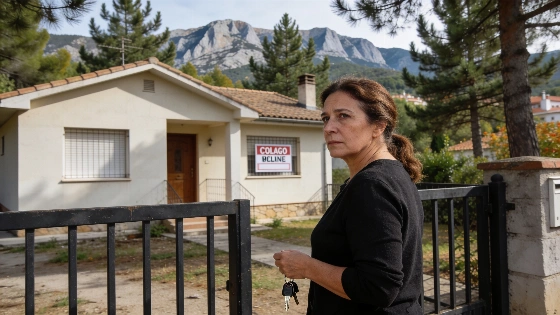
This happened in Collado Mediano, a popular spot near the Navacerrada reservoir. Official records show the house—on parcel B-2 in the Reajo del Roble development—was listed as still under construction. But sources say it may have been finished and that Abascal herself lived there. In Spain, registry records and reality often don’t match. Here, the fallout was real.
In 2018, the building where Abascal lived in Madrid changed ownership, and she was offered the chance to buy her apartment, but was unable to do so.
The Boletín Oficial del Estado published a court notice on June 13, 2000. It named María del Carmen Abascal Martín as the defendant in a mortgage claim from Banco Zaragozano. The case number was 117/99. The bank wanted its money back. The court set the first auction’s opening bid at 20 million pesetas. The date was July 13, 2000. If no one bought the house, two more auctions would follow in September and October. The last one had no minimum price.
Abascal tried to keep her place in the Madrid mountains. Money ran out. The bank couldn’t get paid, so it went to court. The foreclosure was public. Municipal registration data, cited by Urbagestión—the company that later owned her Madrid apartment—suggests Abascal may have lived in the chalet until at least 2001.
Urbagestión had been her landlord for 71 years in a central Madrid flat near the Retiro. In a statement dated September 24, 2001, the company said Abascal was registered in Collado Mediano until 2001. This detail backed up claims that she lived in the chalet before moving back to Madrid. It mattered when Urbagestión tried to evict her from the city apartment. Her lease, signed in 1956 under Spain’s old rent control rules, was challenged under the 1994 Urban Leases Act. That law capped second-generation lease transfers at two years, unless the new tenant had a certified disability of at least 65% or the transfer happened before the end of 2004. In Abascal’s case, the second transfer was in 2005. No qualifying disability was on record.
In September 2026, Abascal became a national symbol of Spain's housing crisis after being evicted from her Madrid apartment at age 87. According to NPR and Reuters, her rent was raised from 500 euros to 2,650 euros per month before being reduced to 1,650 euros following protests. A new agreement allowed her to return home, capping her rent at 30% of her income.
Abascal’s personal property troubles and her public activism cross paths in a way that’s common in Spain’s housing world. As reported earlier, high-profile housing advocates often face questions about their own real estate past. The line between private struggle and public fight gets blurry.
Her failed mortgage and later eviction battles show how unstable life can be, even for those who lead the charge for tenant rights. Spain’s property laws and market rules don’t spare anyone—not even their critics. The facts of her foreclosure and disputed tenancy reveal just how tangled the country’s housing system is. Legal details and personal stories mix with bigger social battles. For anyone watching Spain’s housing debate, Abascal’s story is a sharp example. Private setbacks can echo in public life. The rules of property ownership are still tough. No exceptions.