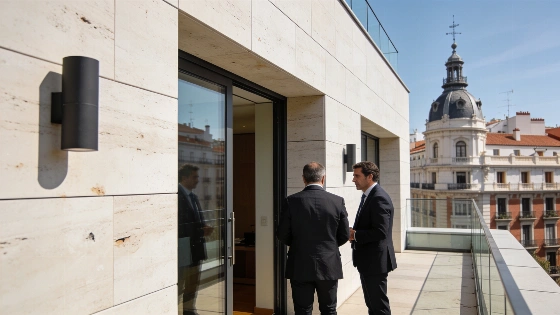
Más Madrid has asked the Tribunal de Cuentas to investigate the regional government’s €6 million purchase of a luxury penthouse in Chamberí. The party questions the necessity and public benefit of the acquisition and its subsequent listing for sale.
The political group Más Madrid has formally requested the Tribunal de Cuentas to examine the purchase of a luxury penthouse in Chamberí by the Community of Madrid’s government, led by Isabel Díaz Ayuso. The party, headed by Mónica García, Rita Maestre, and Manuela Bergerot, is seeking clarification on whether public funds were misused in the acquisition, which exceeded €6 million. The property, initially intended for Ayuso’s use during the renovation of the Real Casa de Correos, was put up for sale shortly after the transaction became public knowledge.
According to the complaint, Más Madrid argues that the purchase may have resulted in a loss of public assets and questions whether there was a genuine public need for such an expensive property. The penthouse, located on the ninth floor of a residential building on Paseo del General Martínez Campos, is situated in one of Madrid’s most exclusive districts, just steps from the Museo Sorolla and close to Paseo de la Castellana. The seller was economist and writer Astrid Gil-Casares, and at the time of sale, the property was occupied by tenants.
The controversy intensified after EL PAÍS revealed details of the purchase, prompting Planifica Madrid, the public company responsible for the acquisition, to list the penthouse for sale. Internal sources indicate that the search criteria for the property were highly specific: a luxury penthouse in Chamberí or nearby, with at least 250 to 400 square meters and a large terrace. These requirements closely matched the features of the apartment ultimately bought by Planifica Madrid.
Despite repeated questions, the regional government has not clarified who authorized the search for such a property in Chamberí, an area closely associated with Ayuso, or why a luxury real estate agency in La Moraleja—specializing in exclusive residences rather than office spaces—was chosen for the transaction. The Ministry of the Presidency, which oversees Planifica Madrid, has also not explained the rationale behind these decisions.
Más Madrid’s submission to the Tribunal de Cuentas highlights several concerns: the potential lack of necessity or suitability of the property for public use, possible unjustified additional expenses, and the risk of financial loss if the penthouse is sold at a price similar to its purchase cost plus taxes and fees. The party calls for a full disclosure of all reports related to the operation, emphasizing that the absence of a thorough evaluation of the property’s suitability could have accounting implications.
The complaint does not assert that financial harm has already occurred but asks the Tribunal to conduct its own investigation to determine if there was any loss to public funds. Meanwhile, the Community of Madrid maintains that the opposition is pursuing unfounded allegations and has requested that Miguel Ángel García Martín, the Minister of the Presidency and head of Planifica Madrid, appear before the Assembly to explain the purchase.
This case echoes other recent scrutiny of public sector decisions in Spain. For example, a previous investigation into hiring practices in the Diputación de Valencia, as reported in a related case covered by russpain.com, also raised questions about the urgency and transparency of public spending, though no irregularities were ultimately found.
In Spain, the Tribunal de Cuentas is responsible for overseeing the legality and efficiency of public sector financial management. Its investigations can lead to administrative or legal consequences if misuse of funds is confirmed. The outcome of the Más Madrid complaint could set a precedent for how similar property acquisitions by public bodies are scrutinized in the future, especially when large sums and high-profile officials are involved.