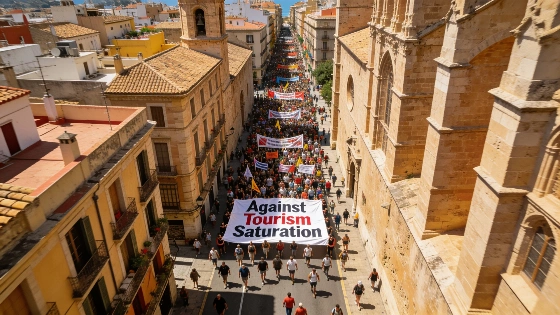
Palma saw 25,000 people march against unchecked tourism growth. Residents demand action on housing, infrastructure, and environmental pressures. The protest signals deepening frustration as visitor numbers hit new highs.
Thousands filled the streets of Palma on Sunday as Mallorca faced its largest protest yet against the island’s surging tourism. According to the National Police, around 25,000 demonstrators marched through the city center, responding to a call from the Menys Turisme, Més Vida platform. Organizers claimed attendance reached 70,000, reflecting widespread concern over the impact of record-breaking visitor numbers—18.9 million in 2025—on daily life, housing, and the environment.
The demonstration, now in its third consecutive year, united over 135 groups, including social, union, and environmental organizations. Protesters carried banners reading “Mallorca al límit” and “Mallorca no está en venta,” underscoring fears that the island’s infrastructure and essential services are stretched beyond capacity. Many participants cited the housing crisis as a key grievance, with young residents saying they are priced out of the market by foreign buyers and short-term rentals. The march began at Plaza de España and wound through major city arteries, ending near the cathedral at Ses Voltes.
This year’s protest was marked by controversy. Organizers had circulated a manual encouraging direct actions against tourist businesses, such as graffiti and lock blockades. Tensions escalated further after two activists were detained and brought before a judge, accused of criminal group membership following vandalism at several real estate agencies. Despite these incidents, the demonstration maintained a largely festive atmosphere, with families, young people, and older residents expressing anxiety about the island’s future.
Calls for change extended beyond housing. Protesters demanded limits on water consumption, protection of natural areas, and an end to the import of waste from Ibiza. The expansion of airports and the dominance of rental cars were also criticized. Farmers joined the march with tractors, highlighting the strain on the primary sector. The debate over tourism’s impact is not new in the Balearic Islands, but the scale of this year’s mobilization signals growing impatience with official responses. The government, led by Marga Prohens, has introduced measures such as restricting private car access, banning tourist apartments, and capping cruise ship arrivals. However, these steps have not eased public frustration, especially as the Social and Political Pact for Sustainability—a forum meant to broker consensus—has failed to deliver decisive action, prompting several groups to withdraw in protest.
Some residents voiced concern that the government is using the sustainability forum to delay meaningful decisions. President Prohens acknowledged public discontent but attributed the crisis to previous administrations. Meanwhile, organizers have announced a new protest for August 8 in Sóller, one of the municipalities most affected by tourism saturation. The situation in Mallorca echoes broader challenges faced by other Spanish regions grappling with the environmental and social costs of mass tourism. In recent years, similar tensions have surfaced in areas hit by natural disasters, as seen when public figures rallied support during the wildfires in Madrid and Ávila, highlighting the complex interplay between tourism, environment, and local communities.
For context, the Balearic Islands have a resident population of just 1.2 million spread across four islands, yet nearly 19 million tourists visited last year. The region’s dependence on tourism has fueled economic growth but also intensified debates over sustainability, resource management, and the right to affordable housing. As the high season approaches, authorities and residents alike face mounting pressure to find solutions that balance economic interests with the well-being of local communities.