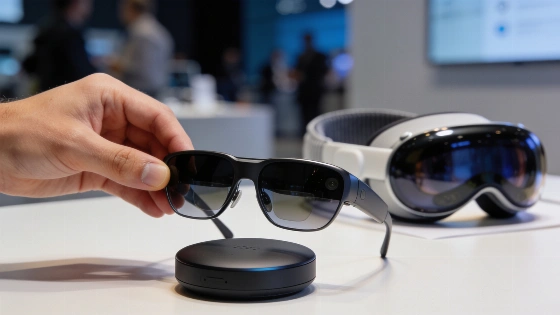
Meta presented a wider hardware range at its annual event in Menlo Park. It includes camera-free Ray-Ban glasses, a pocket AI accessory and a US$1.299,99 VR model due in spring 2027.
Meta's new VR glasses are due in spring 2027 at a price of US$1.299,99. The company showed the model at its annual event in Menlo Park alongside camera-free Ray-Ban Meta Audio glasses and the Muse Charm smart key fob. The lineup gives Meta more hardware built around artificial intelligence and privacy.
The VR Glasses will sit apart from the Quest 4, which is due in 2027. They weigh 100 grams and use a MicroOLED 5K display with Dolby Vision and Atmos. A small puck carried in a pocket handles the processing. The headset does not need controllers.
Ray-Ban Meta Audio will start shipping on 13 October 2026 for US$349. It is Meta’s first smart-glasses model without a camera, retaining microphones and audio features instead.
Mark Zuckerberg presented glasses as Meta's computing platform. The wider catalogue gives that plan a clear commercial shape. CNBC described the event as part of Meta's shift toward AI devices instead of a strategy built only around traditional VR headsets.
That is the split.
Privacy sits at the cheaper end of the range. Ray-Ban Meta Audio are Meta's first glasses without a camera. They weigh 43 grams and offer up to 12 hours of use. Pre-orders start at US$349.
The Ray-Ban Meta Gen 3 starts at US$449. It has a 12-megapixel camera, six microphones and a battery rated for nine hours. Reuters and TechCrunch describe the third-generation model as a camera-equipped step up. Meta is focusing on everyday wear, sound and longer battery life. Ray-Ban Meta Display, which has a holographic lens display, will be available in Europe from US$799.
Meta said Muse Charm would arrive in time for the 2026 holiday season, with deliveries expected in December. The company did not announce a price, leaving the pocket AI accessory as the least transparent part of the new hardware range.
Meta also showed Meta Adventurer as its lower-priced line. Models start at US$249. The products cover different price points and levels of social acceptance. The camera-free version speaks directly to growing privacy concerns. Reuters linked that format to rising sensitivity around recording in public spaces.
For people who do not want a camera near their face, the difference is practical. Not cosmetic.
Muse takes the strategy beyond eyewear. Muse Charm is a key fob with a display, speakers, two cameras, a fingerprint sensor, a microphone and 5G. Meta did not announce its price. The device is meant to keep the Muse agent available at all times and connect it with the user's apps.
According to the presentation, Muse can cancel subscriptions and manage purchases. Paid plans start at US$20 a month. Meta says Muse Secure VM and a Sentinel agent will protect users by auditing the agent's actions.
Meta is entering this phase from a strong market position. The company holds an 81.3% share of the global AI glasses market and sold more than 7 million units in 2025. Those figures give the new range an existing base. This is not a purely speculative launch.
Several questions remain. The source material gives no price for Muse Charm and no launch details for Spain. The Quest 4 also sits outside the announcement's main hardware offer.
Meta set prices and privacy choices around glasses as an AI platform. The range includes camera-free entry models, a display-equipped premium option and a separate VR product. The plan looks commercially coherent. Success in Spain will depend on availability and the missing price of Muse Charm.