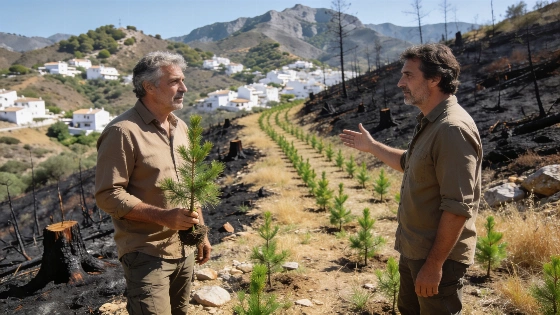
The Sierra de Mijas Ecologist Group has spent four decades confronting wildfires, unchecked construction and water shortages. Their activism has shaped local policy but faces new challenges as the Costa del Sol grows.
In Mijas, a small group of environmental activists has spent 40 years confronting the region’s most persistent threats: wildfires, aggressive urban development and the depletion of natural resources. Founded in 1986 after a devastating fire swept through the Sierra de Mijas, the Grupo Ecologista Sierra de Mijas (GESIM) quickly became a driving force for environmental protection on the Costa del Sol. Their early campaigns targeted illegal waste dumping and the expansion of quarries that steadily consumed the local mountains.
GESIM’s founders, all teenagers at the time, rapidly mobilized the community. Within months, they organized reforestation efforts that drew hundreds of volunteers and began pressing local authorities for stronger environmental safeguards. Their activism soon extended to schools, where they promoted the principle of “think globally, act locally,” and to broader campaigns, such as opposing offshore drilling projects near Punta de Calaburras. The group’s efforts, including human chains and flotillas with support from Greenpeace, ultimately forced Repsol to abandon its plans for marine exploration.
Despite some victories, many of the group’s original concerns remain unresolved. Wildfires continue to threaten the Sierra de Mijas, with the 2022 blaze destroying 2,000 hectares and forcing thousands to evacuate. Activists argue that prevention plans are still not fully implemented by authorities, leaving the area vulnerable to recurring fires. The region’s water supply, once sustained by the local aquifer, is now under pressure from prolonged drought and a population that has more than tripled since the 1980s. Mijas now counts 12 golf courses and nearly 9,000 private pools, intensifying the strain on limited resources.
Unchecked urban growth is another long-standing battle. Since the 1980s, GESIM has protested against sprawling construction, warning that the local land and water cannot support endless expansion. The current urban plan, unchanged since 1999, is seen by activists as outdated and unresponsive to the realities of climate change. The group regularly meets with political parties before municipal elections to present their proposals, but say that engagement with the current administration has stalled since a 2023 power shift brought a new coalition to office.
Generational change is now a pressing issue for the group. While some younger members participate in activities like wildlife censuses and amphibian rescues, the core leadership remains those who founded the group decades ago. They warn that without renewed interest from younger residents, the continuity of local environmental activism is at risk. The challenge is compounded by what they describe as a decline in environmental awareness and a lack of clear communication from local authorities on issues like organic waste collection.
These local struggles reflect broader national trends. According to recent analysis, Spain has struggled to fully utilize EU funds earmarked for wildfire prevention, with many projects incomplete and key initiatives delayed. This context underscores the ongoing difficulties faced by grassroots groups like GESIM, who continue to push for practical solutions amid growing environmental pressures.
Mijas’ experience highlights the complex intersection of rapid development, climate risk and community action on the Costa del Sol. As the region’s population swells each summer and demands on land and water intensify, the legacy of local environmental activism remains both a source of progress and a reminder of the challenges ahead. The story of GESIM is a case study in persistence, adaptation and the ongoing struggle to balance growth with sustainability in one of Spain’s most dynamic coastal areas.