Fine up to €50,000: how security cameras in apartment buildings can turn into a problem. Installing cameras in a residential building without following regulations can cost tens of thousands of euros. Violations are tracked by the AEPD: from missing signs to filming the street and sharing footage. We explain what actually draws penalties and how to avoid a fine.
Surveillance cameras are becoming an increasingly common feature in Spanish residential buildings. However, an attempt to improve security can result in serious financial losses for neighbors. As Talent24h notes, for violations of video data processing regulations, the Data Protection Agency (AEPD) imposes fines of up to 50,000 euros.
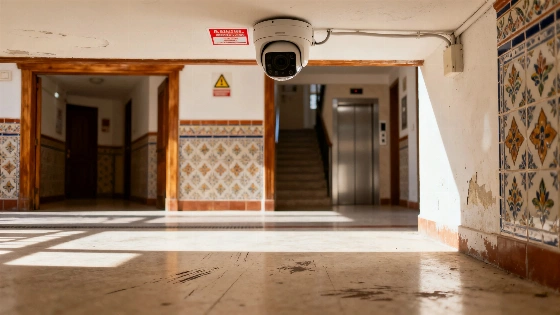
The main reason for sanctions is non-compliance with the General Data Protection Regulation (RGPD). The law strictly regulates where and how video surveillance can be carried out. Before installing cameras, the decision must be approved at a homeowners’ meeting and recorded in the minutes. The system may cover only common areas of the building and a minimal area at the entrance. Filming other apartments, neighboring properties, or a wide section of the street is prohibited.
Common mistakes and fine amounts
The most frequent violation is the absence or incorrect placement of informational signs. By law, at every entrance there must be clear information about who is responsible for data processing, the purpose of the recording, contact details of the responsible party, and residents’ rights. The absence of such a sign results in a fine ranging from 1,000 to 6,000 euros.
If a camera captures part of the street, the penalty can range from 600 to 3,000 euros. Unauthorized surveillance of common areas by an individual resident results in a 600-euro fine. Particularly serious cases, such as the installation of 47 cameras with facial recognition functions in a building without the mandatory risk assessment (EIPD), trigger the maximum fine of 50,000 euros.
Another common mistake is sharing video recordings with third parties or posting them in messengers. In 2025, the AEPD fined one such initiative €20,000 (later reduced to €12,000) for distributing footage via WhatsApp.
What the law requires
The GDPR requires data collection to be minimized: cameras should only record what is truly necessary for security. All recordings must be kept no longer than 30 days, unless there is a strong legal basis for a longer period.
Before launching the system, you must create a data processing register (RAT), restrict access to recordings to only the president or administrator, and annually check the cameras and paperwork for compliance. Any changes are grounds for a new inspection.
How to avoid problems
Experts recommend carefully planning camera placement beforehand, not skimping on legal support, and not ignoring formalities. Even if the system seems simple, violating even one regulation can result in significant expenses for the entire community.
In recent years, the AEPD has tightened control over video surveillance in residential buildings. Practice shows that fines are imposed not only for intentional violations but also for formal mistakes. That’s why, before installing cameras, it’s important not only to discuss the issue with neighbors but also to thoroughly study all legal nuances.