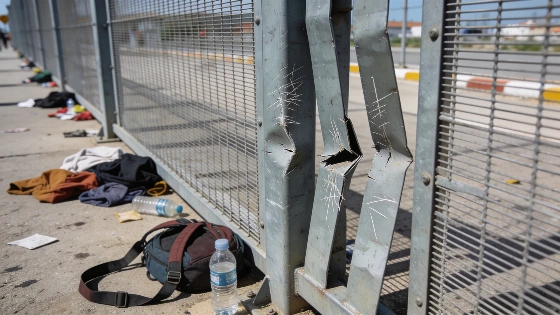
A new gate at the Tarajal border has handed Morocco operational control over a critical crossing point. Spanish and Moroccan officials now dispute the exact location and authority over the installation, raising questions about the management of migrant returns from Ceuta.
Morocco has quietly taken control of a new gate at the Tarajal border, giving Rabat the power to decide when people can cross back from Ceuta. The gate, welded into place in early August, sits in a strip of land where sovereignty is hotly disputed. Spanish police sources say it is Spanish soil, while officials in Madrid insist it is on Moroccan territory. Spanish press reports confirm the gate was installed in early August 2026, during a period of heavy migration and pressure at the border.
This is not a minor detail. The gate is now the only route for returns from Ceuta, and whoever controls it shapes how migration is managed. Police sources quoted by ABC describe the structure as standing in a "no man's land," an area without Spanish patrols but with a visible Moroccan military presence. The Spanish government, meanwhile, calls the gate part of Morocco's second border fence and avoids the sovereignty debate, focusing instead on the need for stronger border security. Spain's Interior Ministry acknowledges that Morocco's control over the gate gives it leverage over the pace and order of returns from Ceuta.
Spanish authorities have announced plans to build a permanent temporary holding center and carry out new works at the Tarajal border crossing, signaling Madrid's preparation for long-term management of the crisis.
Morocco now holds the keys, both literally and figuratively. The gate remains open for now, but Spanish security officials warn that Rabat could close it at any time, without warning. So far, there is no sign that Morocco has blocked returns, but the possibility alone has raised concerns among Spanish officials responsible for the border. Spain's Interior Minister Fernando Grande-Marlaska has said the gate is on "Moroccan territory" and remains open, with ongoing cooperation between the two countries on voluntary returns.
Figures from Spain's Interior Ministry show the scale of the situation. On July 31, officials reported over 25,000 returns after an estimated 50,000 entries. By August 4, the official count had jumped to 72,000 arrivals and more than 70,000 departures, with some moments seeing up to 150 crossings per minute. These numbers reflect the chaos of late July, when the border was overwhelmed and humanitarian groups in Ceuta, including one led by Sabah Hamed, stepped in to provide food and shelter. Official estimates vary: the Ministry of Territorial Policy reported about 4,000 voluntary returns to Morocco since August 10, while Interior Minister Marlaska later cited a figure closer to 5,000 by the end of August.
Disputed territory
The core of the conflict is not the existence of the gate, but exactly where it stands. Spanish police sources argue the installation is on Spanish land, just before the Moroccan line, and point to the lack of Spanish patrols as evidence of Moroccan control in practice. Officials in Madrid say the gate is on Moroccan soil and is simply an extension of existing border infrastructure. No official maps or coordinates have been released, and the term "no man's land" does little to clarify the legal status.
During the late July and early August crisis, Tarajal became one of the main sites of mass attempts to enter Ceuta, including crossings by swimming. Moroccan authorities deployed police and military along the perimeter to block approaches to the border, according to recent reports.
This lack of clarity is not accidental. Without transparent documentation, both sides can stick to their narratives, while the reality on the ground shifts in Morocco's favor. Spanish agents now watch from a distance as Moroccan forces decide who crosses and when. Spanish sources also report that thousands remain in Ceuta after the crisis, putting pressure on local resources and temporary shelters.
After the July surge
The timing of the new gate is no accident. It appeared after the mass crossings on July 30, when Spanish Prime Minister Pedro Sánchez admitted that Moroccan police allowed border breaches for ten hours, though he stopped short of accusing Rabat of planning the event. A police report obtained by Reuters described a reduced Moroccan presence and a permissive response, but Morocco rejected these claims, blaming traffickers and social media for the surge.
Meanwhile, Spain's Interior Ministry ordered judicial authorization for the expulsion of migrants detained for alleged crimes. This does not mean automatic returns and does not address the fact that Morocco now controls the new gate.
What is known and what remains unclear
There is no doubt that a new gate exists within the border fence system, and that Morocco currently controls its operation. The Spanish government says the installation is on Moroccan territory, but has not provided independent verification or official documentation to confirm the exact location. There is also no public evidence that the gate has been used to block returns, though the risk remains as long as Rabat holds exclusive authority over its use.
Foreign Minister José Manuel Albares has repeated that Ceuta and Melilla are integral parts of Spain and called for more involvement from the European Union in their protection. These statements, however, do not resolve the practical question of who controls the Tarajal crossing today. Until official maps and formal responses are released, Morocco has gained a new lever over the border, and Spain is left managing the consequences from the sidelines. This episode highlights how fragile Spain's border arrangements are, and how quickly operational control can shift, even as political leaders argue over lines on a map.