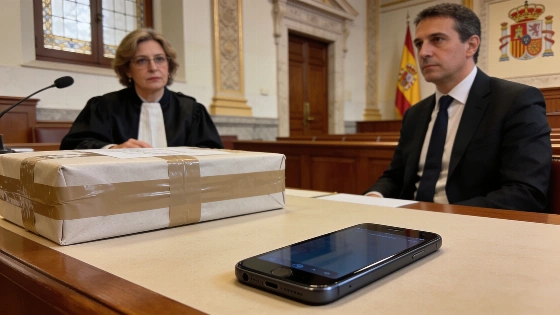
The National Court has initiated a fresh, court-supervised copy of Juan Manuel Serrano’s phone. The move follows legal challenges over the device’s initial seizure and the validity of previous data extraction by the UCO.
The National Court in Madrid has taken the unusual step of ordering a new, supervised cloning of the mobile phone belonging to Juan Manuel Serrano, former president of Correos and ex-chief of staff to Pedro Sánchez. This action comes after Serrano’s legal team contested both the original seizure of the device and the legality of an earlier data copy performed by the Guardia Civil’s Central Operative Unit (UCO) without the presence of Serrano or his lawyer.
The phone, central to an ongoing investigation into alleged irregularities at the state holding Sepi, was placed in a sealed room at the court on Tuesday morning. The cloning process, expected to last several hours, is being carried out under strict judicial oversight. Once completed, the UCO will be able to access all messages and emails stored on the device, but only after the court unseals the room in the presence of Serrano and his defense.
Serrano’s lawyer, Bernardo del Rosal, has consistently argued that the initial confiscation of the phone in late May was improper, as the judge had not yet declared Serrano an official suspect at that time. The dispute intensified when the UCO informed Judge Santiago Pedraz that it had already copied the phone’s contents in July, but did so without the required legal supervision. This contradicted the judge’s own instructions, which called for the process to occur with all parties present at the court.
During Tuesday’s proceedings, Serrano and his lawyer refused to recognize the validity of the previous copy made by the UCO. As a result, the court’s legal officer initiated a new, fully supervised cloning. Serrano and his defense are scheduled to return to court the following morning for the official unsealing of the room and to verify the integrity of the process.
Judge Pedraz, in a recent ruling, rejected the defense’s request to nullify the phone’s seizure. He argued that the absence of formal charges at the time did not prevent the UCO from securing the device, pending a judicial decision. The judge also stated that neither law nor jurisprudence requires the affected party’s presence for the data extraction to be valid, although he had ordered it in this specific case to ensure transparency. Pedraz further dismissed concerns about the chain of custody, noting there was no evidence of tampering and that the phone’s contents should be presumed intact for investigative purposes.
As the investigation moves forward, Serrano’s defense has requested that the court filter the phone’s data, limiting the case to messages directly related to the alleged irregularities at Sepi, which focus on suspected kickbacks in several operations. The case has drawn attention due to Serrano’s previous roles at the heart of government and the sensitive nature of the evidence involved.
This legal battle over digital evidence echoes broader debates in Spain about procedural safeguards and the rights of those under investigation. Similar disputes over the handling of evidence have surfaced in other high-profile cases, such as the recent controversy in Valencia over the Mislata fairground tragedy, where the court’s approach to evidence and responsibility was also closely scrutinized. For more on how Spanish courts handle complex evidence disputes, see this report on the Valencia court’s decision in the Mislata case.
For context, the Audiencia Nacional (National Court) is Spain’s top criminal court for major corruption and financial crime cases. The UCO is a specialized unit of the Guardia Civil focused on complex investigations. Sepi, the state industrial holding, has been under scrutiny for alleged irregularities involving public contracts. The outcome of this case could influence future standards for digital evidence handling in Spanish judicial proceedings, especially in politically sensitive investigations.