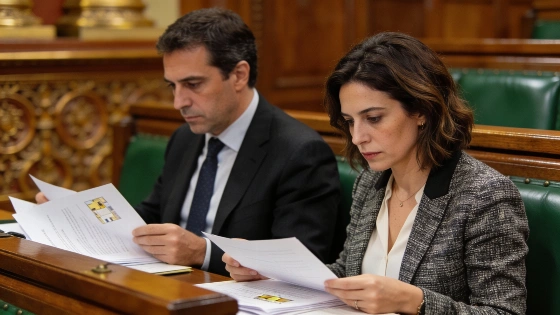
Forty-five percent of Spain’s Congress members declared ownership of at least two properties, according to official records. As the government races to address the housing crisis, the personal real estate portfolios of lawmakers are drawing new attention.
Spain’s housing crisis has put lawmakers’ own property holdings under a harsh light. After the government rushed out emergency housing decrees following the eviction of Maricarmen, attention turned to the deputies themselves. The numbers are hard to ignore. Out of 350 Congress members, 45% reported owning two or more homes as of February 2026. These figures come from declarations reviewed by EL CORREO. Official government data shows the concentration is even higher: 86% of deputies own at least one property. Independent reviews of parliamentary disclosures confirm this.
Deputies together hold 613 properties. Of these, 159 lawmakers own more than one home. Rental income is common. Fifty deputies reported earning money from letting out property. The amounts range from €1,180 to €28,300. The records do not show how often these payments come in. Most deputies share ownership with family, often because of inheritance. Some own as little as 10% of a property. Nearly 19% of Congress—65 out of 350—declared rental income from real estate. This group includes Prime Minister Pedro Sánchez and opposition leader Alberto Núñez Feijóo, according to government sources.
On September 29, 2026, the Spanish government approved two new housing decrees aimed at expanding affordable housing and strengthening protections for social housing, with immediate effect pending parliamentary ratification.
Still, the largest group is those with just one home. That’s 138 deputies, or 39% of the chamber. At the other end, 51 lawmakers declared no real estate at all. Most likely, they live with relatives, partners, or rent. This group includes 18 from PSOE, 13 from PP, 9 from Vox, and 8 from Sumar. A few come from smaller parties. Every member of EH Bildu, PNV, and ERC reported at least one property. Regional gaps are clear. Deputies from Valladolid have the highest average number of properties. Those from La Rioja and Badajoz average less than one each. In the Basque Country, 18 deputies declared 24 properties in total.
Some lawmakers stand out. One PP deputy from Valladolid declared 19 properties. A PSOE deputy from Barcelona listed 13. She received nine apartments as a donation in 2010 and bought four more later. In 2022, she reported over €18,000 in rental income. The Valladolid deputy inherited most of her portfolio. She owns 17 apartments at 50% and smaller shares in others. Official records show both Sánchez and Feijóo declared rental income. Sánchez reported €12,845. Feijóo reported €5,584 from their properties.
Regional patterns tell more. Valladolid’s five deputies top the list for average property holdings. La Rioja and Badajoz deputies average less than one property each. In the Basque Country, 18 deputies declared 24 homes. Some, like Patxi López Álvarez, own three. Others hold property as far away as Extremadura or France. EH Bildu’s Marije Fullaondo La Cruz and Oskar Matute García de Jalón both reported rental income. Matute’s Bilbao apartment is leased to the public company Alokabide.
The government has also introduced fiscal measures as part of the housing package, including reducing VAT to 4% for publicly funded and social housing, and launching new mechanisms to protect the public housing stock at the state administration level. These steps are part of a broader response to what officials now call Spain's 'main problem': the housing affordability crisis.
Party lines matter too. PP deputies average 1.99 homes each. PSOE members hold 1.72. Esquerra deputies average just 1.15. The biggest portfolios sit mostly with the two main parties. Four of the five largest property holders are from their ranks.
These facts land as the government tries to push through new housing decrees. The fate of these measures now sits with a chamber where many have a personal stake in real estate. The timing is sharp. Spain’s housing crisis is getting worse. The lawmakers in charge of reform are themselves invested in property. This tension surfaced before, when rent controls tightened and landlords faced new rules.
The data is clear. Spain’s political class holds significant property, often inherited and sometimes used for rental income. The debate over housing policy is now personal. Lawmakers’ portfolios are central to the story. The government faces a tough task. It must bridge the gap between public need and private interest—inside its own walls.