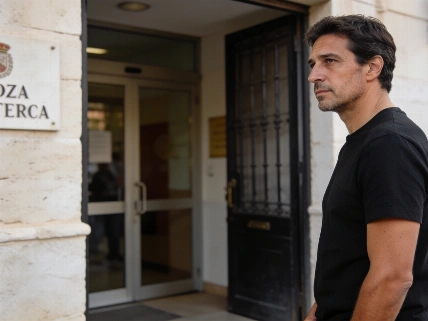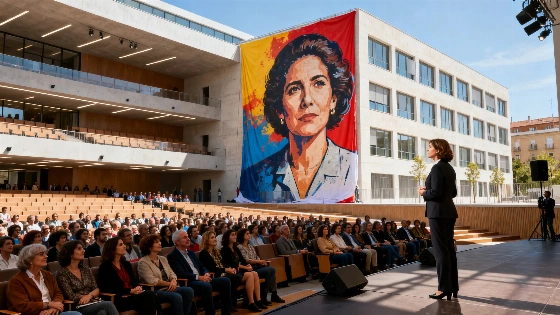
After 25 years away from the public eye in Ponferrada, Nevenka Fernández appeared in the city this weekend. The event, held at the Fundación Ciudad de la Energía and organized by the Ministry of Equality, filled an auditorium with 300 attendees, including long-time supporters and a new generation familiar with her story.
Fernández became a national figure in 2001 when she accused Ponferrada’s then-mayor, Ismael Álvarez, of sexual harassment. Álvarez belonged to the Partido Popular and the same political group as Fernández. The case ended with Álvarez’s conviction in 2002, described as Spain’s first conviction of a politician for sexual harassment. Fernández also faced public scrutiny and personal attacks, and eventually left the city. Her return brought visible emotion and a standing ovation, reflecting the case’s lasting resonance with the public.
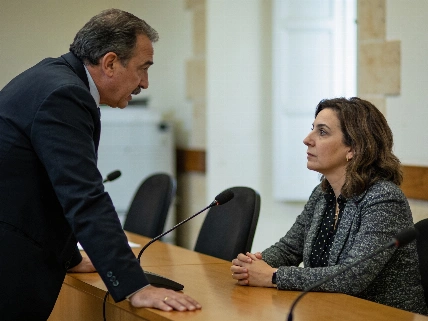
At the event, Fernández shared the stage with Charo Velasco, the former socialist councillor who supported her during the proceedings. Both women stressed the importance of political courage and solidarity in confronting harassment. Fernández acknowledged the personal cost of speaking out and said she has since found peace and fulfilment in her life.
The gathering brought together feminists who had supported Fernández in 2001 and younger attendees who were children at the time of the case. The audience applauded repeatedly. Asked how Ponferrada could further repair her public image, Fernández pointed to the gathering itself as a form of restitution, prompting another round of applause.
A mural featuring Fernández’s likeness was unveiled on the building’s façade as part of the commemoration. Sara Aagensen, the government’s third vice president, said the mural is intended to tell women facing harassment that they are not alone. The event highlighted the continuing relevance of Fernández’s case in Spain’s broader debate over gender equality and public accountability.
The case remains part of Spain’s cultural debate. A stage adaptation written and directed by María Goiricelaya revisits the events through a mix of historical fact and dramatic reconstruction. Gema Matarranz stars, with Alex Furundarena and Ana Ibáñez also in the cast. The production begins with Fernández’s 2001 complaint and the conviction that followed in 2002.
Spain’s institutional response has since broadened. From 3 October 2025, Sections for Violence Against Women have investigated offences against women’s sexual freedom, including sexual harassment and trafficking for sexual exploitation, as well as cases involving female genital mutilation or forced marriage. The Judicial Statistics Service estimated that the expanded responsibilities could increase the courts’ national workload by 12.9%, with a 20% increase reported in Catalonia.
In the second quarter of 2026, Spain’s specialized courts for violence against women registered 55,712 complaints and assisted 50,106 women, increases of 9.81% and 7.64% respectively compared with the same quarter of 2025, information from figures reported by Servimedia. The courts recorded 16,553 judgments, including 13,676 convictions, or 82.62%, and 2,877 acquittals, or 17.38%. For sexual violence outside the partner or former-partner context, the specialized sections received 3,962 complaints and recorded 3,967 women victims. The data also included 232 offences of harassment with a sexual connotation.
These figures describe a substantially expanded institutional structure since the Ponferrada case, which remains a landmark in Spain’s political and legal treatment of workplace sexual harassment. Fernández’s return and the public response brought that history into the present, while keeping attention on the pressures faced by people who report abuse.