Hantavirus outbreak on cruise ship: cases of human-to-human transmission confirmed. Cases of Andes hantavirus transmission between passengers have been reported on the MV Hondius cruise ship. Authorities and the WHO consider the risk to the general public low, but the investigation is ongoing.
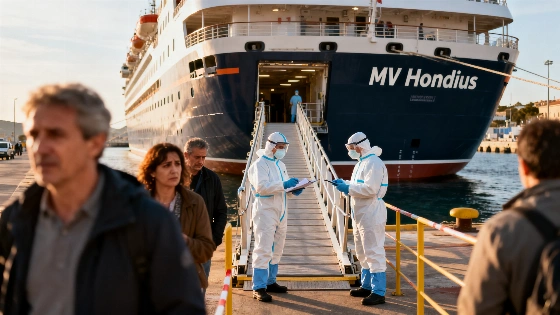
Five cases of Andes hantavirus infection have been confirmed aboard the cruise ship MV Hondius, sailing under the Dutch flag in the Atlantic, with another three people under suspicion. The outbreak has attracted the attention of international and national health authorities due to the rare human-to-human transmission of this virus. According to the WHO, those affected include citizens of the Netherlands, United Kingdom, Germany, and Switzerland, two of whom have died and one is in critical condition.
Virus transmission on board the ship
Experts believe that the initial patients—a couple from the Netherlands who had recently returned from South America—may have been infected before boarding the ship. However, specialists say further spread of the infection occurred on board, where close contact among passengers facilitated virus transmission. Representatives from Spain's Ministry of Health and the WHO emphasize that such transmission is unusual for hantavirus but possible during prolonged and close contact with symptomatic patients.
Monica Garcia, Minister of Health, reminded that the primary mode of infection is contact with rodent excretions, but in enclosed spaces such as a ship, the risk of human-to-human transmission increases. Pedro Gullón, Director of Public Health, noted that the greatest danger arises when it is impossible to maintain distance from those who are ill.
Lessons from past outbreaks
Previously, similar cases of Andes hantavirus transmission were recorded in Argentina, where, in 2018–2019, the virus spread among participants at social events, as well as in 2002 during a bus trip. Studies showed that in some instances, infection even occurred through relatively superficial contact if the source had a high viral load. In the current situation, according to WHO representatives, conditions on the vessel may have played a decisive role in forming the transmission chain.
According to the National Epidemiology Center, some of the infected may have contracted the virus on land, while others became infected already on board the ship. Pello Latasa, Vice-President of the Spanish Society of Epidemiology, also believes this is a case of human-to-human transmission.
Investigation details and response measures
The WHO has confirmed eight cases, five of which are laboratory-confirmed. Among them: a 70-year-old man from the Netherlands who died on the vessel; a 69-year-old woman from the Netherlands who died in South Africa; a British national in intensive care; a German citizen who died on May 2; and a patient from Switzerland who was placed in isolation. Three more people, including the ship's doctor, have been evacuated with suspected infection.
The organization is tracking contacts, including airline passengers who traveled with one of the victims. The WHO and national services emphasize that the risk to the general public remains low and further spread is unlikely. The priority remains isolating patients and preventing new cases.
The outbreak on the MV Hondius sparked a discussion on the readiness of services for rare infections and the role of confined spaces in the spread of viruses. In similar situations, as noted in the article on insurance challenges for medical workers in Andalusia, issues of safety and staff protection come to the forefront.
According to experts, the further development of the situation depends on the virus incubation period and the effectiveness of contact monitoring measures. The WHO continues to monitor and does not rule out new cases among passengers and crew members.