Blue Origin Launch Pad Restoration May Be Delayed Until 2028. Blue Origin’s launch pad in Florida suffered serious damage after the New Glenn rocket explosion. NASA expects repairs to be completed no earlier than 2028. This affects the timeline for lunar missions and the launch of Amazon’s satellites.
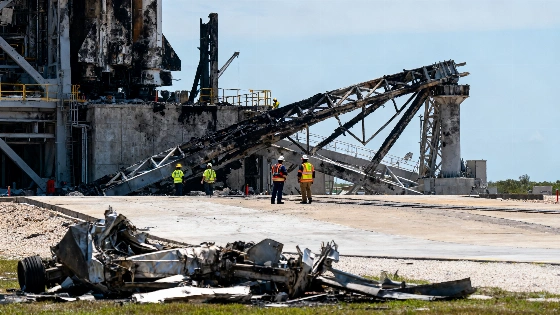
Restoration of Blue Origin’s launch pad at Cape Canaveral after the New Glenn rocket explosion may take up to two years, with the launch of new NASA and commercial missions postponed until at least 2028. NASA chief Jared Isaacman told CNBC that infrastructure damage was severe and would require lengthy repairs.
The incident occurred during a New Glenn rocket static fire test, when the vehicle ignited on the pad, causing fire and destruction. All Blue Origin employees were unharmed, but Jeff Bezos’ company now faces a complete overhaul of its launch schedule. Isaacman noted that restoring the launch complex is a complex task, and even in the best-case scenario, Artemis program missions cannot launch before 2028.
NASA has signed several contracts with Blue Origin, including for the delivery of two lunar rovers and the construction of a lunar base. According to Isaacman, these projects were originally scheduled for 2028, which now coincides with the potential completion of launch pad restoration. Meanwhile, Blue Origin plans to use New Glenn to launch heavy payloads into orbit, competing with SpaceX’s Falcon Heavy and United Launch Alliance’s Vulcan.
Blue Origin CEO Dave Limp stated that some infrastructure survived, and the damaged service tower can be repaired without a complete replacement. The company has already developed a restoration plan and expects to resume test launches by the end of this year. However, Blue Origin currently has only one main launch complex, with a second under construction at the Vandenberg base in California.
The launch failures affect not only NASA but also other Blue Origin clients. In particular, Amazon had planned to send 48 satellites into orbit for its Leo project in the coming weeks, aimed at competing with SpaceX's Starlink. Amazon is under obligations to the U.S. Federal Communications Commission to deploy half of its satellite constellation by next month. Additionally, Blue Origin is relied upon by AST SpaceMobile, whose shares dropped significantly after the accident.
Restoring launch pads after major accidents traditionally takes years. Isaacman emphasized that NASA is ready to provide Blue Origin with expertise and assistance in analyzing the causes of the incident. According to CNBC, experts are already studying the chronology of similar cases in the history of space launches to speed up the recovery process.
In the context of delays in the aerospace industry, it is worth noting that postponements and strategy revisions are also happening among other major players. For example, Ford recently announced that it would begin production of the Bronco in Valencia only in 2028, reflecting a general trend toward long-term planning of large industrial projects. Read more about this in the article about the relocation of Bronco production and new Ford models for Europe.
For reference: the Artemis program provides for the return of American astronauts to the Moon by 2028. Blue Origin plays a key role in these plans; however, following the New Glenn accident, NASA may be forced to make greater use of alternative rockets such as the Falcon Heavy. The restoration of the Blue Origin site will be a determining factor for the schedule of future missions and commercial launches.