The Ministry of Culture has awarded Pilar Albarracín Spain's top visual arts prize. The €30,000 award also includes an individual exhibition at Museo Reina Sofía.
The 2026 prize includes an individual exhibition at Museo Reina Sofía as well as a €30,000 payment. The Ministry of Culture has given it to Pilar Albarracín for a career built around Spain's familiar cultural images. Her performances and installations examine gender, folklore, tradition and collective identity.
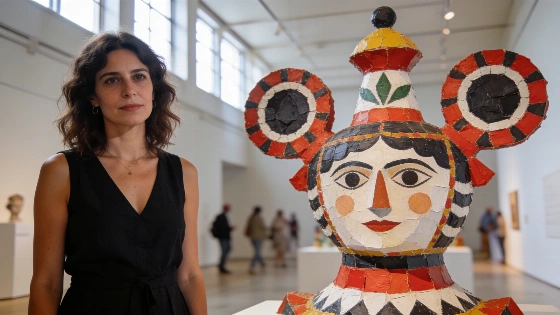
Albarracín's work crosses performance, photography, video, installation and live action. She often puts her own body at the centre. That approach lets her question stereotypes around "lo español" and focus on Andalusian women and traditions still seen in daily life across parts of southern Spain.
Alongside the €30,000 payment, the 2026 award includes an individual exhibition at Museo Reina Sofía, giving Albarracín’s work a new institutional platform in Spain.
The jury called her career one of the most singular and recognisable in Spanish contemporary art. Its decision points to a long critique of cultural images and power structures. EFE reported that the Ministry's official decision recognised a sustained body of work focused on gender, tradition, folklore, collective identity and power.
That is the point. Albarracín uses irony, theatre and social criticism to show how images of Spanishness are made and repeated. References to flamenco, regional customs and the visual codes of España cañí become material for examination. Her feminist view keeps them from being treated as unquestioned heritage.
Her work has also reached major institutions abroad. The Seville-born artist has shown at MoMA PS1 in New York, the Hamburger Bahnhof in Berlin, the Musée d'Art Moderne de la Ville de Paris and Kiasma in Helsinki. The jury said that international presence brought her work into wider debates about contemporary art and Spanish culture.
EFE reports that the jury specifically highlighted performance, photography, video and installation as the means through which Albarracín reworks Spanish cultural images. El País independently confirmed both the award and its €30,000 value, describing the recognition as a response to her challenge to Spain’s cultural stereotypes.
Recent solo exhibitions include 'Take a Knife and Open My Heart' at American University Museum in Washington D. C. in 2023 and 'Acciones peregrinas' at CGAC in Santiago de Compostela in 2021. France has been an important setting for her work. There, she presented 'No apagues mi fuego, déjame arder' in Paris in 2020 and 'Anatomía Flamenca' in 2017.
In Spain, her projects have included 'Que me quiten lo bailao' at Tabacalera in Madrid in 2018 and 'Ritos de fiesta y sangre' at CAC Málaga in 2016. The record reaches well beyond Spain.
Her work has travelled to Latin America and Asia. Examples include her 2019 solo presentation at MAIIAM Contemporary Art Museum in Thailand and 'Recuerdos de España' at Instituto Cervantes de Tokio in 2010. Her work is held in collections including Museo Reina Sofía, Es Baluard, CAAC Sevilla, Artium, MUSAC, CA2M and DA2, along with institutions in France. A related report on Madrid's cultural and social landscape offers another view of how public identity can become a subject of attention.
The previous edition went to Fina Miralles. Albarracín now joins a list that includes Teresa Lanceta, Rogelio López Cuenca, Dora García, José María Yturralde, Àngels Ribé, Ángel Bados, Ángela de la Cruz and Juan Hidalgo.
The prize recognises an artist who refuses to separate aesthetics from social experience. Albarracín's work asks who gets represented, how an image is made and which power relations it keeps in place. Tradition gets questioned here.