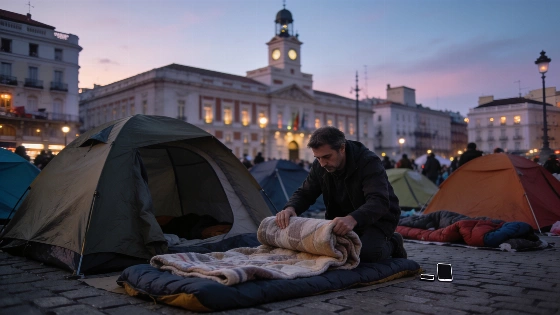
Around 150 tents remain in Madrid's Puerta del Sol after a calm night. Protesters say they will stay until the Government approves measures against evictions.
By Tuesday, the Government is expected to approve a housing decree with measures against evictions. That deadline has kept around 150 tents in Madrid's Puerta del Sol after a quiet first night. Hundreds of people say they will stay until the decree is approved. The camp has turned the city's central square into the focus of a protest that recalls the 15-M movement.
The measure is not yet approved. Protesters plan to remain in Sol at least until Tuesday and want what they describe as a real answer to the housing crisis.
The protest was triggered by the eviction case of 87-year-old Maricarmen Abascal, which has become a symbol of Spain’s wider housing crisis and campaign against evictions.
The night passed without incidents. About 120 tents stood across the centre of the square. Some participants slept in them. Others used yoga mats, sleeping bags or the ground. Small groups stayed awake during the cool night. Guardia Civil and Policía Nacional officers monitored the camp. No altercations were reported.
The numbers from the square are not identical. Initial reports put the central group at about 120 tents. The camp later reached around 150. People gathered food and water on site. Police kept a limited presence and observed the protest without intervening.
The 26 September march drew tens of thousands of people, although estimates differed sharply: a government delegation put attendance at about 25,000, while organisers cited as many as 300,000 participants. The overnight camp then extended the pressure campaign into Puerta del Sol.
The programme goes beyond sleeping in the square.
The first scheduled activity was a workshop on "direct action". People in the camp discussed ways to organise the protest. At around 13.00, the platform for nursery schools is expected to arrive after a march from Atocha. Organisers also plan banner-making workshops, drawing activities for children and book presentations.
Sindicato de Inquilinas, the tenants' union, is organising the camp. The group has called the Maricarmen case a point of no return. Its demands include urgent action against evictions, stronger protection for renters and measures to stop people from losing their homes.
Other activities will take the protest into the city. Organisers plan tours of blocks bought by vulture funds. Other Maricarmen continue to resist eviction in those buildings. The name has become part of the camp's language as participants link the wider housing dispute to individual cases.
Protesters often call the proposed package the "Maricarmen decree". Reports describe protection against evictions, automatic extensions of rental agreements and extra safeguards for tenants. The campaign wants the package discussed at Tuesday's Council of Ministers meeting.
Location matters here. Puerta del Sol is also home to the headquarters of the Community of Madrid. The camp sits directly outside that institutional centre. Organisers are keeping the housing dispute visible in one of the capital's best-known public spaces instead of limiting it to a single march.
The 15-M comparison is deliberate. That movement emerged in the same square 15 years ago in opposition to precarious living conditions. The current camp is smaller, but it uses the same setting. Participants connect housing costs and evictions with a demand for government action.
The legal picture is more complicated than the protest slogan suggests. A previous royal decree-law was published in Spain's Official State Gazette, the BOE, on 4 February 2026. It entered into force immediately. The current mobilisation seeks additional or tougher measures. It is not simply saying that Spain has no housing regulation.
According to AFP and ABC News, the main political risk will come after any government approval. The measures still need to pass through Parliament. The Sánchez government may not have a stable majority. That uncertainty helps explain why organisers have tied the camp to a specific political deadline instead of treating the march as a one-day demonstration.
For now, the protest has survived its first night without incidents and remains in place. The planned Tuesday decree is the next point of confrontation. Campers have tied their presence to its approval. Until then, Sol will function as both a camp and a public test of whether the proposed housing measures can answer the people gathered there.