A new underground wastewater plant will be built in Matalascañas, moving away from the vulnerable coastline. The project aims to resolve long-standing environmental and infrastructure issues. Residents demand a binding timeline and greater transparency.
After years of pressure and repeated environmental warnings, the Confederación Hidrográfica del Guadalquivir (CHG) has agreed to overhaul Matalascañas’ wastewater system. The new Estación Depuradora de Aguas Residuales (EDAR) will be built underground, set back from the coastline, and designed to blend into the town. CHG says this option was chosen as the "most favorable" among those studied, mainly to reduce the plant's visibility and better fit it into the urban area.
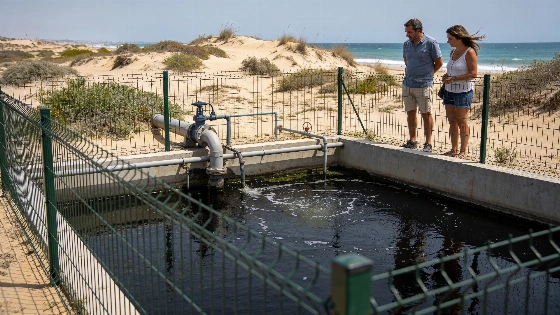
The decision comes as the current facility, damaged by winter storms and criticized for not meeting European standards, faces growing scrutiny from residents and regulators. Recent storms have made the plant's problems worse, and local groups warn that its condition threatens the nearby Doñana ecosystem.
The preparatory phase for the new EDAR project was funded with €466,000 by the Dirección General del Agua, as confirmed in official communications.
The issue is not just technical. The Asociación de Propietarios de Matalascañas has stepped up its campaign, filing complaints with the Ministry for Ecological Transition (MITECO), the Junta de Andalucía, CHG, the Almonte Town Hall, the European Commission, and the Doñana Participation Council. They want a binding construction schedule, full transparency on the environmental review, and clear guarantees that the new plant will not repeat the failures of the 1990s facility. This pressure from several institutions shows the conflict is also political, as reported by Huelva24.
The latest environmental study, funded by the Dirección General del Agua with €466,000, compared four locations and two treatment technologies. The chosen plan—an underground facility using MBBR (Moving Bed Biofilm Reactor) biological treatment—was picked for its low visual impact, technical feasibility, and smaller environmental footprint, according to Europa Press. Other options were ruled out because they would have required longer pipelines, more complicated land purchases, or would have caused more ecological disruption.
With the location and technology decided, the next step is drafting the Environmental Impact Study, which authorities expect to finish before the end of the year. Only after the required environmental declaration is granted will the construction tender be announced. CHG describes this as a key step toward a modern, environmentally sensitive solution for Matalascañas, a town whose wastewater management is especially important because of its proximity to Doñana National Park.
CHG has already prepared the service specification documents (Pliego de Bases de Servicios) for the construction project, signaling a transition from the solution selection phase to detailed design. The Environmental Impact Study is expected to be completed by the end of the year, after which the project will require an environmental declaration before moving to the construction tender stage.
Meanwhile, local frustration is growing. The current plant, built in the 1990s, has not kept up with demand and has drawn formal criticism from the European Union. Residents have started a petition on Change.org, arguing that the situation puts both public health and the protected Doñana ecosystem at risk. Similar grassroots campaigns have appeared in other parts of Spain where infrastructure has fallen behind environmental requirements, as seen in recent disputes in Valencia.
Despite technical progress, the timeline remains a major concern. Official data cited by Huelva24 and MITECO indicate that the new EDAR is unlikely to be operational before 2031, even in the best-case scenario. Residents and environmental groups worry that slow administrative procedures and the lack of a binding schedule could mean more environmental damage before the new plant is finished.
Coastal towns across Spain are under pressure to modernize water infrastructure as climate risks and EU deadlines approach. The Matalascañas case shows the gap between official announcements and what happens on the ground: while authorities highlight technical advances and environmental care, local communities are still waiting for real action. Until the new plant is running, both regional and national water policy face questions—and the patience of Matalascañas’ residents is running out.