Nine citizens will decide whether Begoña Gómez and Cristina Álvarez are guilty. Their selection will pass through lotteries, legal exclusions and challenges before the trial begins.
Nine Madrid residents will decide whether Begoña Gómez and Cristina Álvarez are guilty of the offences attributed to them. On 21 September 2026, Judge Juan Carlos Peinado sent Gómez and her adviser to a jury trial over alleged influence peddling and embezzlement, according to reports by El Mundo and other Spanish media. Their names will come from more than 3,000 potential jurors. Several rounds of exclusions and challenges will follow. The final jury will be formed only if the specific draw for this trial takes place before 31 December.
If that deadline is missed, the candidates will come from the general lists being prepared for the following two years. The case therefore depends not only on the judge's decision to close the investigation. It also depends on which electoral roll is in force when jury selection begins.
The proceedings have lasted nearly two and a half years since the complaint was admitted in April 2024. The transfer to a jury trial came shortly before Judge Peinado’s departure from office, according to several Spanish reports.
The first pool was created on 17 September 2024 by the Electoral Census Office. In the Community of Madrid, it includes more than 3,000 people. That includes 2,846 residents of the capital who initially meet the legal conditions for jury service.
The conditions are specific. Candidates must be Spanish citizens over 18 who can read and write, live in Madrid, retain their political rights and have enough capacity to perform the role. The law also says that disabled people cannot be excluded automatically. The justice system must provide the means they need to serve.
The exclusions cover a wide range of people. They include those convicted of an intentional offence who have not been rehabilitated, people facing criminal proceedings, people in detention or serving a sentence, and public officials suspended in criminal proceedings. The list also excludes the prime minister, the King and his family, police officers, judges, prosecutors, prison officials, practising lawyers and teachers of legal subjects.
The selection proceeds in stages: a second lottery identifies 36 candidates, after which questionnaires and challenges reduce the group to roughly 20 before the final composition is determined by drawing names on the day proceedings begin.
Potential jurors must report any incompatibility or legal reason that prevents them from serving after receiving notice that they are on the preliminary list. The first lottery does not produce the trial panel. A second draw will select 36 names. Those people must be notified at least 30 days before the proceedings open.
The letter will include a questionnaire. Candidates will have five days to return it. They may give reasons such as living abroad, being over 65, having served on a jury during the previous four years, holding a job of general interest or facing a serious family disruption. The law's list of excuses is not closed. A properly supported objection can remove someone before the final stage.
At least 20 candidates must remain on the day of the trial for the last selection. The presiding judge will question them again about incompatibilities. The parties can challenge candidates who do not meet the requirements.
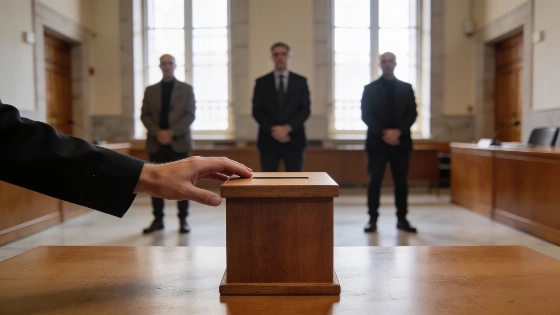
Names will then be drawn one by one from an urn. The prosecution and defence may question each candidate, but not about political views. They can also make up to eight challenges without giving reasons: four for the accusations and four for the defence. The respective sides must agree on those objections.
The final panel will have nine jurors and two substitutes. Each person will swear or promise to perform the duty faithfully and impartially, assess the accusation and evidence, decide whether the defendants are guilty or not guilty, and keep the deliberations secret. The commitment must be made without hatred or affection. Refusing to do so carries a fine of 50,000 pesetas, equivalent to 300.51 euros.
The case has drawn intense political attention. The jury's composition will determine which citizens carry the constitutional duty of judging it. As earlier coverage reported, the Government has said Gómez remains innocent and expects the jury to act fairly. The procedure leaves little room for informal selection. Eligibility rules, lotteries, excuses and challenges will reduce the pool step by step. Reports by La Vanguardia and other Spanish outlets have also stressed that the judge presides over the proceedings, while the jury decides the facts and guilt.
That process explains how the panel will be formed. The nine jurors will not be chosen through a public contest of opinions. They will come from a legally filtered list, with both sides given defined opportunities to remove candidates. Whether the specific draw takes place before 31 December will decide which two-year pool supplies the panel. The final oath will put impartiality and secrecy at the centre of the trial.