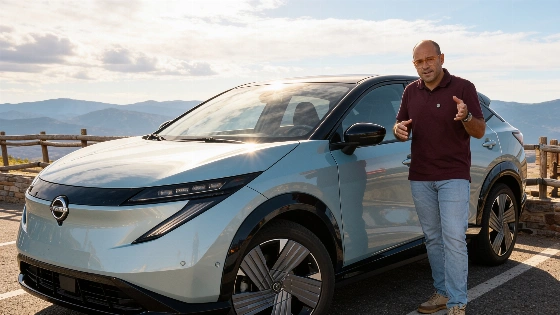
The updated Ariya is the electric vehicle for a Spanish itinerary linking Puebla de la Sierra’s Japanese-influenced sculpture collection with a kaiseki restaurant in Madrid. Nissan quotes up to 536 km of homologated range.
Puebla de la Sierra has only 93 residents and an outdoor sculpture park with 138 works. It is the first cultural stop on a Spanish itinerary pairing the updated Nissan Ariya with places connected to Japanese art and food.
The route also gives a real-world setting for the Ariya’s electric driving technology. Nissan offers battery choices of 63 and 87 kWh, with a homologated range of up to 536 kilometres. That is a manufacturer figure; actual range depends on driving conditions.
Nissan’s electric-car history dates back to the LEAF, launched in 2010. The company says it was the first manufacturer to back fully electric cars. The Ariya now sits at the top of its electric range. Its available e-4ORCE all-wheel-lead system uses one motor on each axle. Nissan says the setup can deliver more than 300 horsepower and improve grip.
In Puebla de la Sierra, the cultural connection began with local painter and sculptor Federico Eguía. He helped create “El Valle de los Sueños” in 2005. The park’s international links led to a partnership with Osaka-based Reijinsha and an agreement establishing the Museo de Dibujo, Obra Gráfica y Obra Contemporánea Japonesa. The village became Spain’s first municipality to host a space devoted exclusively to contemporary Japanese painting.
The museum holds hundreds of works by artists from Spain and abroad. Eduardo Chillida and Broto are among the graphic artists represented. The collection also includes work by Antonio López. Juán Genovés is represented as well, alongside works by Picasso. It also holds Alejo Vera’s studies for the dome of Madrid’s Basílica de San Francisco el Grande.
On the road, the Ariya’s updated cabin centres on two 12.3-inch screens, now incorporating Google’s operating system and connectivity features. Nissan has kept physical controls, tucking them discreetly into the dashboard. Wireless phone charging is another addition. The driver-assistance systems have also been updated.
The e-Pedal function lets the driver accelerate and slow the car using the accelerator alone. Lifting off applies regenerative braking strongly enough to bring the Ariya to a stop, information from the source material. The feature is aimed particularly at urban driving.
The car carries the DGT’s CERO label, a related to the topic detail for a visit to Madrid. A separate question about electric mobility in Spanish cities is explored in our earlier scooter report.
The route ends at Sen Omakase in Madrid’s Chamartín district. Its kaiseki-inspired meal spans three spaces and lasts more than two and a half hours. Chef Steven Wu prepares a 35-bite omakase menu, pairing local ingredients with products from Japan. The meal closes with a traditional Japanese tea ceremony.