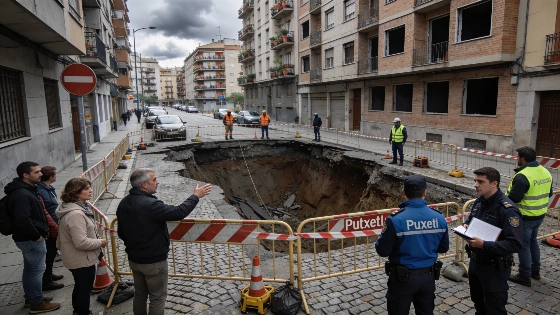
Barcelona authorities confirm that 40% of families evacuated after the L9 metro sinkhole still have no timeline for returning home. Most affected residents will be able to return by early August, but many remain in limbo.
Barcelona’s Putxet neighborhood continues to face disruption after the sinkhole caused by L9 metro construction forced dozens of families from their homes. While the Generalitat has announced that around 60% of evacuated households will be able to return between next week and early August, there is still no schedule for the remaining 40% of residents, leaving many in prolonged uncertainty.
The first group cleared to return are those living at 6 Rubinstein Street, comprising 11 apartments and 4 commercial premises. Their return is expected next week. The following phase, planned for the first week of August, will see residents of 54 Sant Gervasi de Cassoles—30 homes and one business—allowed back. However, for the rest of the affected buildings, no date has been set, and authorities have emphasized that safety assessments must be completed before any further returns are authorized.
Pilar Díaz, the Generalitat’s delegate in Barcelona, and Ramon Ramírez, director general of Mobility Infrastructure, explained that the government’s priority remains the structural safety of all buildings. They noted that 90% of claims from affected families have already been processed through a dedicated support office, which covers extraordinary expenses resulting from the incident.
In addition to residential support, the Catalan government has met individually with local business owners impacted by the evacuation. A new financing line from the Institut Català de Finances (ICF) has been launched to help cover rent and other ongoing business costs during the disruption.
For those families who still cannot return, the Generalitat plans to announce specific support measures next week. Among the options under consideration are legal mechanisms to allow tenants to temporarily suspend rent payments without penalizing landlords. A special unit, in coordination with the Conselleria de Territorio, will be set up to manage these cases efficiently, according to Díaz.
Concerns remain high among residents living near the affected zone. During the government’s briefing, a neighbor from 55 Sant Gervasi de Cassoles voiced worries about the stability of the ground, especially with the approach of winter and the risk of heavy rains. Officials reiterated that their immediate focus is on the safe, phased return of evacuees, with further technical studies and stabilization work to follow.
This incident is not isolated in Barcelona’s metro construction history. In a previous case, a gas explosion at the Plaça de Sants metro works resulted in injuries and significant disruption, highlighting ongoing challenges with underground infrastructure projects in the city. Details of that event can be found in this report on the Plaça de Sants metro accident.
Barcelona’s metro expansion has long been a complex undertaking, with multiple phases and significant engineering challenges. The L9 line, in particular, has faced delays and technical setbacks over the years. Sinkholes and ground instability are rare but serious risks in urban tunneling, often requiring extensive safety checks and sometimes leading to prolonged displacement for residents. The city’s authorities have repeatedly stressed the importance of prioritizing safety over speed in these situations. As the situation develops, affected families and businesses are relying on government support and clear communication to navigate the ongoing disruption.