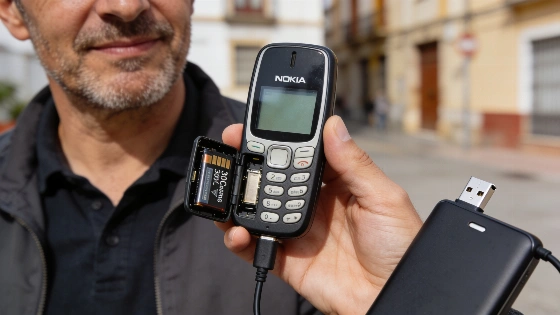
HMD’s new Nokia 300 Charge boasts up to 40 days of standby and a removable 3700 mAh battery that can power other devices. Yet its reliance on 2G networks makes it a risky bet for buyers in Spain and beyond, as 4G support is nowhere to be found.
Forty days of standby is a bold claim in 2024, but that’s exactly what HMD is advertising with the Nokia 300 Charge. The catch? The phone only works on 2G networks, which are disappearing fast across Europe. For anyone outside a reliable 2G zone, that long battery life might not matter at all.
HMD, the company behind today’s Nokia phones, is pitching the 300 Charge as a simple device for people who care most about battery life. The phone’s 3700 mAh removable battery is the largest HMD has ever put in a basic Nokia. They say it can last up to 40 days on standby or handle nearly 38 hours of calls. You can even use it as a power bank: the phone offers 10 W reverse charging to other devices over USB-C, which is rare for a phone in this category.
According to CHIP, the Nokia 300 Charge is currently only available in the Philippines, with a local price of around $34–$38, and there is no official confirmation of a global release date or pricing from HMD.
But the main selling point comes with a major drawback. The Nokia 300 Charge is locked to GSM 900/1800, so it only connects to 2G. As more European carriers shut down their 2G networks, this isn’t just a technical detail—it could mean the phone won’t work at all in many places. Anyone interested in buying one needs to check if their carrier still supports 2G, or risk ending up with a phone that can’t make calls or send texts.
Otherwise, the phone is as basic as they come. It has a 2.4-inch QVGA screen, a simple rear camera, and a physical keypad. There’s 4 MB of RAM and 4 MB of storage, but you can add a microSD card up to 32 GB. It runs the S30+ operating system and comes with a few preinstalled apps, so it’s not a true "dumb phone," but it’s nowhere near a modern smartphone. There’s also a 3.5 mm headphone jack and a bright LED flashlight, which HMD says is four times brighter than the one on the Nokia 105, though that’s based on their own tests.
Fans of the old Nokia 1100 might see some similarities, but HMD isn’t calling this a reboot. The focus here is on battery life and the ability to charge other devices, not nostalgia. That sets it apart from the retro reissues Nokia has released in recent years.
Industry sources highlight that the 2G-only limitation is especially risky for European buyers, as many countries—including France and Germany—are actively shutting down 2G networks, making such devices potentially unusable in affected regions.
Infobae
Despite being announced internationally, the Nokia 300 Charge isn’t listed in HMD’s Spanish catalog, and there’s no confirmed price or release date for Spain. There is documentation for a European model (TA-1773), but that doesn’t guarantee it will be sold locally. Anyone thinking about importing one should be extra careful, given the 2G-only support and the lack of features found on even the cheapest smartphones.
The long battery life and reverse charging might appeal to travelers, outdoor workers, or anyone who wants a backup phone. But without 4G, it’s a tough sell. As recent analysis points out, mobile connectivity is now essential, and devices that can’t keep up with current networks risk becoming useless overnight.
HMD is betting that some users will trade modern features for battery life and simplicity. But for most people in Spain and much of Europe, the lack of 4G makes the Nokia 300 Charge a risky choice. Unless HMD updates the phone to support newer networks, it’s likely to remain a niche curiosity rather than a practical option.