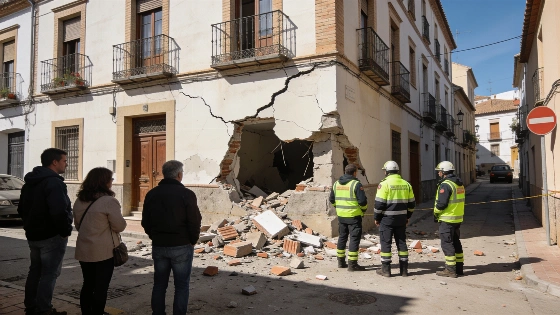
Granada’s Alhendín region has experienced more than 40 earthquakes in a single day. Several tremors were felt by residents, leading to property damage and forced evacuations. Authorities are monitoring the situation.
Granada’s Alhendín area has been shaken by an intense series of earthquakes, with more than 40 tremors recorded in just one day. The surge in seismic activity has left residents in the city and the southern metropolitan zone on edge, as several of the quakes were strong enough to be felt and have already caused material damage and evacuations.
According to data from the Instituto Geográfico Nacional (IGN), at least four earthquakes reached or exceeded a magnitude of 2 mbLg, and six were perceptible to the population. The majority of the tremors, however, went unnoticed by most people. The renewed seismic activity comes after a brief period of relative calm, with Thursday’s events marking a clear uptick in both frequency and intensity.
The day began with a 2.3 mbLg earthquake at 7:41 a.m., its epicenter located one kilometer deep northeast of Armilla. Just minutes later, at 7:52 a.m., another shallow quake of 2.4 mbLg struck northwest of Churriana de la Vega. By 9:07 a.m., a 2.1 mbLg tremor with an epicenter in Armilla was also felt, followed by a stronger 2.4 mbLg event in Otura at 9:21 a.m. After midday, a 2.2 mbLg quake with an epicenter in Vegas del Genil was reported at 2:45 p.m., classified as intensity III, or ‘weak’, by the IGN.
The current seismic sequence in Alhendín began on August 14 with a 3.7 Mw earthquake and escalated with two significant events of 4.8 Mw in the early hours of August 15 and the morning of August 18. The epicenters of these major quakes were pinpointed in Alhendín and the Gójar-Otura area. These stronger tremors triggered widespread alarm, prompting many residents to leave their homes and gather in the streets. The aftermath included visible cracks in walls, fallen cornices, damaged chimneys, and other structural issues. Some people suffered minor injuries, and several families remain displaced as authorities assess and repair the affected buildings.
Seismic activity is not uncommon in southern Spain, particularly in the Granada region, which sits atop several active fault lines. The area has a long history of moderate to strong earthquakes, and local authorities maintain protocols for rapid response and public safety. The IGN continues to monitor the situation closely, while emergency services remain on alert for further developments. For comparison, other regions in Spain have also faced natural disruptions recently, such as the heavy storms that impacted Galicia, as reported in recent coverage of severe weather events in the north.
Residents in Granada and its metropolitan area are advised to stay informed through official channels and follow any instructions from emergency services. The ongoing seismic sequence highlights the importance of preparedness in regions with known geological risks. While most earthquakes in the current series have been minor, the potential for stronger events remains, underscoring the need for vigilance and timely response from both authorities and the public.