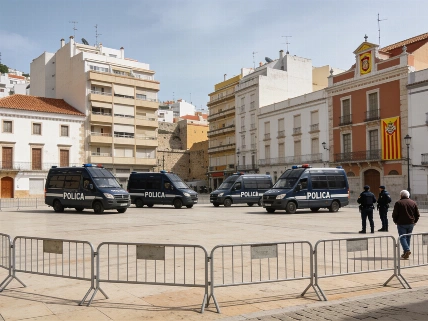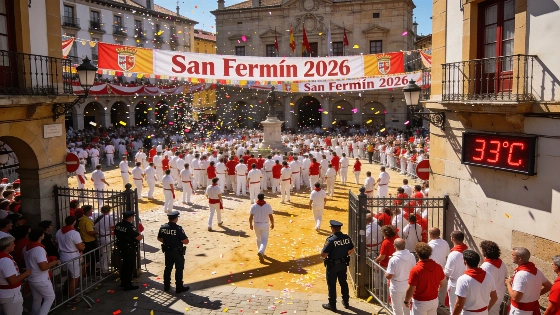
San Fermín 2026 officially opened in Pamplona at midday on July 6, as thousands crowded into the Consistorial Square amid rising temperatures. The city, dressed in its signature white and red, saw anticipation build from early morning. Municipal police managed access points as the plaza filled to near capacity well before the scheduled start. The festival traditionally runs from July 6 to 14: the chupinazo at noon marks its official opening, while the “Pobre de mí” ceremony at midnight on July 14 brings it to a close.
This year, the honor of launching the chupinazo fell to Clint Jean Louis Fernández, subdirector of the emergency service, and Araceli Sergio Aguilera, a nurse from the Tafalla mobile ICU. Their words echoed across a crowd of 12,000, marking the start of 204 hours of uninterrupted celebration. Information from AEMET, temperatures had already reached 24°C by late morning, with forecasts predicting a peak of 33°C at noon and up to 39°C by late afternoon. The agency issued an orange alert for high temperatures in the Navarre capital, raising concerns for participants and emergency services as festivities began. AEMET’s Meteoalerta system provides forecasts for potentially dangerous weather phenomena up to 72 hours ahead, then updates them as conditions develop. It supports public authorities and emergency services as they communicate and manage risks.
By mid-morning, the old town’s streets had become a sprawling open-air dining area, with locals and visitors gathering for traditional San Fermín breakfasts. The festive atmosphere was palpable, but so was the heat, which kept climbing as the day went on. Organizers and authorities urged caution, especially for those planning to stay outdoors for extended periods.
The Consistorial Square was nearly full two hours before the official start, reflecting strong public interest after a year of anticipation. The excitement was evident among the crowd and the chosen chupinazo launchers, who spoke about their emotions in an interview with Diario de Navarra. The day began at a refreshing 18°C, but the rapid temperature rise added urgency to preparations and safety measures.
The chupinazo signals the start of the festival, whose program extends far beyond the opening ceremony. San Fermín combines religious observances with street celebrations. Its program includes concerts and fireworks, while communal meals bring people together. The daily bull runs take place from July 7 to 14 along an 875-metre route ending at Pamplona’s bullring. The regional tourism authority, Visit Navarra, presents the festival as a major international attraction and highlights official efforts to promote sustainability and coexistence, alongside safety measures that include campaigns against sexist violence.
The heat also formed part of a wider public-health concern across Navarra during summer 2026. Regional monitoring reported 249 cases of heat-related illness, 96% more than in 2025. Authorities also issued 25 alerts for medium or high health risk. A separate early-July heat episode accounted for 23% of reported cases and 19% of hospital admissions in the period covered by the report, according to figures reported by Europa Press. The data underline the demands high temperatures can place on participants, medical teams and emergency services during a large public gathering.
San Fermín draws national and international attention. As noted in recent coverage of the festival’s expanded live broadcasts and bull runs, Pamplona’s celebration remains a focal point for Spanish culture and tourism. The festival’s traditions and large crowds, compounded by high temperatures, make coordinated public-safety efforts especially impressive.
San Fermín’s origins date back centuries, and the chupinazo is now recognized as the symbolic start of one of Spain’s most renowned festivals. Its 204 hours of activity put sustained demands on city infrastructure, with emergency services and hospitality businesses also under pressure. The 2026 edition opened amid intense heat, focusing attention on how Pamplona balances the celebration with public safety as events continue through the closing ceremony at midnight on July 14.