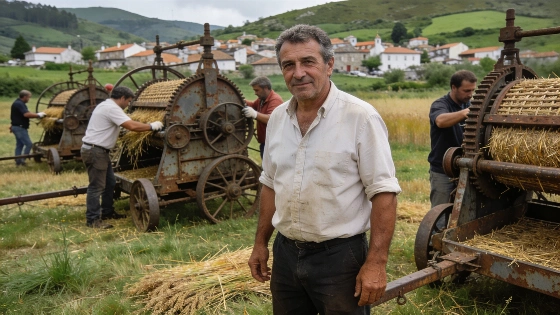
José Francisco Fernández, known as Paquiño, keeps agricultural machines over 100 years old running for Galdo’s traditional harvest festival. As fewer people know how to operate them, he worries the craft will disappear when he no longer can. A recent documentary brought his story to a wider audience.
In the small Galician village of Bravos, José Francisco Fernández Fernández—better known as Paquiño—has become the last guardian of a vanishing tradition. At 63, he maintains and operates threshing machines that have survived more than a century, bringing them to life each summer for the Festa da Malla de Galdo in Viveiro. But as the number of people able to handle these complex, heavy machines dwindles, Paquiño is increasingly concerned that their legacy will end with him.
Paquiño’s connection to the malla runs deep. His father spent four decades traveling from village to village with these machines, which once relied on oxen and cows for transport. Today, tractors have replaced livestock, but moving the massive equipment—some pieces weighing over a ton—still requires a coordinated effort from more than twenty people. Despite no longer growing wheat himself, largely due to wild boar damage, Paquiño preserves the knowledge and skills needed to keep the machinery running.
Tradition Under Threat
The Festa da Malla de Galdo, revived in 2024 by Luis Pérez and Carmen Gabilondo of Panadería de Galdo, has become a focal point for this endangered craft. The bakery, established in 1961, began cultivating its own wheat and organized the first festival that September. By 2025, over forty locals from Viveiro and Ourol joined the effort, but the challenge of finding enough hands—and expertise—remains acute. Paquiño agreed to participate on the condition that he would receive help transporting and assembling the machines, a task that grows harder each year as the rural population shrinks.
During the festival, the entire process is recreated: setting up the machinery, separating grain from chaff, milling flour, and finally baking bread. This chain of work connects Galdo’s event to other projects across Galicia that strive to keep artisanal bread-making alive. Yet, as Paquiño points out, the lack of younger people willing or able to learn these skills threatens the survival of the tradition. Similar concerns have been voiced in other trades, such as marble working, where decades of expertise risk being lost without new apprentices.
Documenting a Disappearing World
This year, filmmaker Borja Zausen captured Paquiño’s story in a documentary simply titled “Paquiño.” The film follows the painstaking process of assembling, operating, and dismantling the ancient machines, offering a rare glimpse into the labor and coordination required. Its screening during the festival moved many in the audience to tears, highlighting the emotional weight of a tradition on the brink of extinction. Zausen had previously chronicled the revival of the malla in his 2025 film “La Malla” and earlier documented the Panadería de Galdo in “Oda al Pan de Galdo.”
Rural Decline and the Future
The threat to Galdo’s malla is inseparable from the broader issue of rural depopulation. Where O Rego da Ponte once housed around forty residents, only five or six remain today. “The youngest here are my wife and me,” Paquiño notes, underscoring the difficulty of passing on knowledge in a community that is aging and shrinking. Official statistics from the Instituto Galego de Estatística show Ourol’s population at just 965 in 2025, with an average age of 56.11 years and only one birth recorded against twenty deaths that year.
For Paquiño, involving children and young people in the festival is essential to keeping the memory of the malla alive. This year, he took particular satisfaction in seeing children help carry straw and participate in the work. “You have to teach it so it’s not lost,” he insists. As long as he is able to move the machines and find support, he plans to continue his role in the Festa da Malla de Galdo.
The struggle to preserve agricultural heritage is not unique to Galicia. In France, for example, a farmer’s decision to give away surplus potatoes led to unexpected consequences, as reported by RUSSPAIN, highlighting how rural traditions and livelihoods face new pressures across Europe.
Paquiño’s story is a reminder of how quickly living knowledge can disappear when communities shrink and traditions lose their practitioners. The fate of his century-old machines now depends on whether the next generation will step forward to keep them running.